
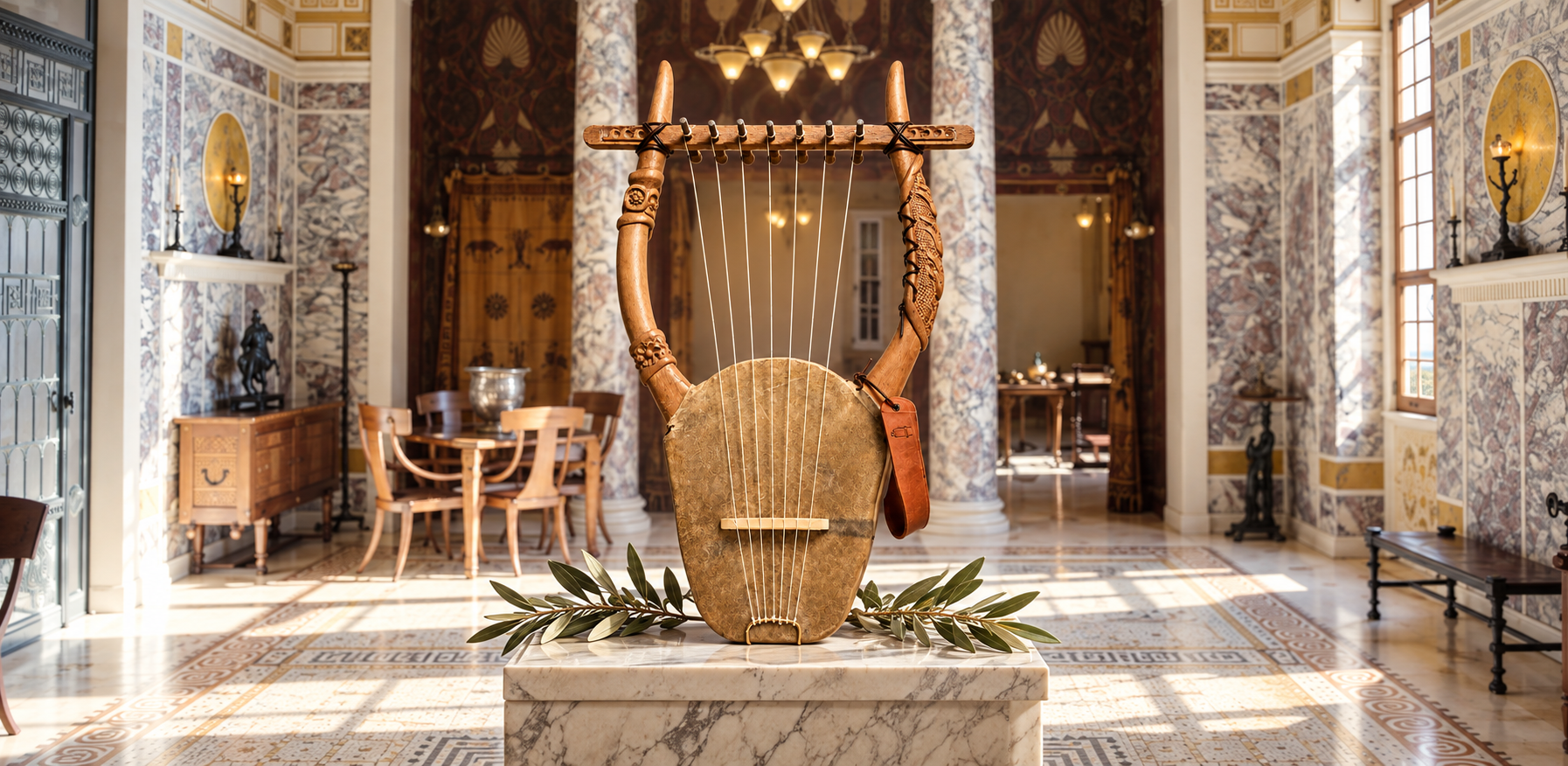
ILS Newsletter – September 2026 | Issue 07
This newsletter is available in English and Greek.
Scroll down or click here for the Greek version.
From Athens to the French Riviera

Two Remarkable Summer Concerts for the Ancient Greek Lyre
This summer, the ancient Greek lyre travelled from one of the most important sites of ancient Athens to a unique “Greek” corner of the French Riviera, in two remarkable concerts that brought the past into living dialogue with the present.
On 29 July, at the Ancient Agora of Athens, Nikos Xanthoulis and Myrsini Margariti brought together the sound of the ancient Greek lyre and the human voice in a place where the history of the city remains powerfully present. It was a musical encounter in the very heart of ancient Athens, where the contemporary voice of the lyre acquired a particularly meaningful resonance.

One month later, on 28 August, the journey continued in France. At the remarkable Villa Kérylos in Beaulieu-sur-Mer, near Nice, Les Lyristes – Evangelia Kopsalidou, Nikos Xanthoulis, and Myrsini Margariti – presented a musical journey spanning more than two thousand years of history.
Ancient hymns and poetry, surviving musical fragments, elements of the Greek musical tradition, and contemporary creation came together in a setting that seemed almost made for such an evening: a residence inspired by the ancient Greek world, overlooking the Mediterranean.

From the Ancient Agora to Villa Kérylos, the lyre continues its journey — not as the sound of a distant past, but as a living musical voice that continues to find new spaces, new audiences, and new forms of expression.
Iliad at the Museum
Anecdote of the Month

As told by Nikos Xanthoulis
1987. One of the new productions of the Greek National Opera was Verdi’s Don Carlo, conducted by Byron Fidetzis.
We are at the scene in which Rodrigo has gone to the prison to see Don Carlo. There, he is shot by an agent of the Inquisition and dies in Don Carlo’s arms, but not before revealing that Elisabeth will meet him at the Monastery of San Yuste. It is one of the most moving moments in the opera, as Rodrigo knowingly sacrifices himself for his friend.
During one of the performances, the late stage manager Manos Mitsakos was waiting in the wings, ready to fire the shot—but the gun failed to go off. He quickly tried twice more. Nothing.
But the opera had to go on. Rodrigo had to die.
So Manos Mitsakos gave up on the gun and simply clapped his hands loudly.
Rodrigo died. What else could he do?
The members of the orchestra, however, had understood exactly what had happened. They bent down behind their music stands, laughing so hard that they could barely play.
At precisely that moment, a dramatic passage for two trumpets in parallel thirds begins. I looked over at the second trumpeter beside me. He, too, was hiding beneath his music stand.
Then I looked at the conductor.
He gave me such a fierce look that there was absolutely no doubt about what I was expected to do.
I put the mouthpiece to my lips and began to play—while laughing—with a result that can only be described as tragicomic.
A friend who had been watching the performance later told me that I had played that passage with extraordinary tragic intensity, with a wonderfully trembling quality to the sound…
Perhaps just a little too much.
The Kitharist Playing a Harmonic

On shard no. 201740, originating from what was most probably a closed-form red-figure vessel, a kitharist wearing a chiton is depicted holding a remarkably crafted kithara. His left hand is positioned in such a way that he appears either to be preparing to produce, or to have just produced, a harmonic on the fourth string.
With this particular fingering, it is evident that he cannot be plucking the string with the left hand; rather, he is lightly touching it at a specific point. The performer locates this point with great precision—or, perhaps more accurately, feels where it lies—so that the string can vibrate in the appropriate way and produce a rich harmonic sound.

The fourth string is the mese of a seven-stringed kithara or lyre. As a string, the mese constitutes the central note of the seven-note system and, correspondingly, the central string of the kithara or lyre (Solon Michaelides, The Encyclopedia of Ancient Greek Music, MIET, Athens, 1982, p. 206). In the Harmony of the Spheres (Nicomachus, Enchiridion 3, C.v.J. 241–2, Mb 6–7), the mese corresponds to the Sun.
The point at which the index finger of the left hand touches the string appears to lie approximately at the two-thirds position required to produce the second overtone, sounding an octave plus a fifth above the fundamental.
If we assume that the seven strings are tuned according to a diatonic scale, the kitharist is therefore producing a pitch two octaves above the first string. For example, if the tuning is A2–B2–C3–D3–E3–F3–G3, the musician produces an octave plus a fifth above the D string—that is, A4, two octaves above the initial A2.
However, even if the instrument were tuned according to the chromatic or enharmonic genus, the mese would remain in the same structural position: a fourth above the first note of the system.
The expression on the kitharist’s face vividly conveys the concentration required to produce such a demanding sound. In this depiction, one can recognize something common to inspired musicians throughout the ages: at such moments, they do not merely see—they listen, and they feel the beauty of sound.
Note: The ancient Greek kithara was essentially a larger, more powerful form of the lyre, with a larger soundbox, used primarily by professional musicians.
The Hypolydian Harmonia (Modern Locrian Mode)

The Hypolydian Harmonia in the Ancient Sources
The Hypolydian harmonia (F-G-A-B-C-D-E-F) is among the most enigmatic concepts in ancient Greek music theory. Although its name is known from the later theoretical tradition and survives in medieval terminology, the surviving ancient evidence concerning its character and function is remarkably limited. Any attempt to reconstruct its meaning therefore requires a careful examination of the extant sources and a strict distinction between what the ancient authors actually attest and what constitutes later scholarly interpretation.
Plato
The earliest major theoretical discussion of the harmoniai appears in Plato’s Republic (398e–399a). There, the philosopher examines the harmoniai from the perspective of education and ethos, rejecting certain of them as unsuitable for the moral formation of the guardians of his ideal state. More specifically, the Mixolydian and the Syntonolydian are rejected as mournful, while the Ionian and the Lydian are dismissed as soft and convivial. Only the Dorian and the Phrygian are retained.
The Hypolydian, however, is nowhere mentioned in this passage. This omission is of particular importance, since modern scholarship has often attributed to the Hypolydian characteristics that in fact derive from Plato’s discussion of the Lydian harmonia. From a philological standpoint, such an identification cannot be substantiated. Plato provides no direct information whatsoever concerning the Hypolydian.
Aristotle
A similar situation is encountered in Aristotle’s Politics (Book VIII, 1342a–b). Aristotle acknowledges that the various harmoniai differ in their ethos and exert distinct psychological effects upon the listener. He describes the Mixolydian as producing a more solemn and mournful disposition, the Phrygian as enthusiastic and emotionally stimulating, and the Dorian as expressing moderation and balance.
Yet once again, the Hypolydian receives no specific description. Aristotle’s importance for the study of the Hypolydian lies not in any direct testimony concerning this particular harmonia, but rather in his confirmation of the fundamental ancient conception that each harmonia possessed its own distinctive ethos and musical identity.
Pseudo-Plutarch
The treatise De Musica, conventionally attributed to Pseudo-Plutarch, is one of the most important sources for the history of ancient Greek music. Its author preserves earlier traditions concerning Terpander, Olympus, Sacadas, and other musicians, while examining the development of the harmoniai and the transformations that Greek musical practice underwent over time.
Its value for the study of the Hypolydian is primarily indirect. The author treats the harmoniai not as abstract scales but as living musical realities, each possessing its own distinctive character and historical function. Nevertheless, even here no explicit description of the ethos or musical structure of the Hypolydian harmonia survives. Consequently, the contribution of Pseudo-Plutarch is historical and theoretical rather than specifically informative with regard to this particular harmonia.
Aristides Quintilianus
The most important—and, in practice, the only systematic—ancient source for the Hypolydian harmonia is Aristides Quintilianus. In his treatise De Musica (On Music), Book I, Chapters 9–11, he preserves the most complete surviving account of the so-called ancient harmoniai and the octave species (eidē dia pasōn).
Aristides presents the well-known sequence:
Mixolydian – Lydian – Phrygian – Dorian – Hypolydian – Hypophrygian – Hypodorian
This sequence constitutes one of the most important testimonies to ancient Greek modal theory and most probably preserves an earlier Aristoxenian tradition.
From the perspective of the modern revival of the seven-stringed lyre, Aristides’ sequence of the seven harmoniai acquires particular practical significance. By tuning the seven strings to B–C–D–E–F–G–A and making use of the natural harmonics produced by each string, the performer is able to explore in practice a considerable part of the pitch world presupposed by ancient Greek theory. This practical experience strongly suggests that the harmoniai were not merely abstract theoretical constructions, but living musical realities directly connected with the capabilities of a seven-stringed instrument.
The lyre thus becomes a key to the interpretation of the ancient sources, enabling the researcher to investigate through performance questions that often remain ambiguous at the purely theoretical level.
In the conventional modern representation of the octave species (harmoniai), the Hypolydian corresponds to the species F–F, whereas the Lydian corresponds to C–C. This correspondence should not be interpreted as an identification with modern scales or tonalities. It is simply a schematic representation of the position occupied by each octave species within the ancient theoretical system.
The essential point is that Aristides does not treat the harmoniai merely as intervallic arrangements. His presentation suggests that they constitute complete musical entities, each possessing its own distinctive identity. It was precisely this observation that led R. P. Winnington-Ingram to argue that the ancient concept of harmonia is not equivalent to the modern concept of a scale, but corresponds more closely to what we would today call a musical mode or a modal idiom.
The Hypolydian therefore appears not as an isolated succession of pitches but as a member of a broader family of related harmoniai. Its position immediately after the Dorian and before the Hypophrygian suggests that its relationship to the other harmoniai was structural and functional rather than merely numerical.
Conclusion
The direct evidence provided by the ancient sources concerning the Hypolydian harmonia is considerably more limited than modern scholarship has often assumed. Neither Plato nor Aristotle offers a specific description of it. Pseudo-Plutarch preserves valuable historical traditions but does not discuss this particular harmonia in detail. Our principal source remains Aristides Quintilianus, who places the Hypolydian within a coherent system of harmoniai, allowing us to understand it not as a simple scale but as a distinctive modal formation within ancient Greek music.
The surviving evidence allows us to state with certainty only that the Hypolydian was recognized as one of the harmoniai of ancient Greek music theory and that it belonged to a network of related modal forms. Its precise musical reality remains an open field of research, making the Hypolydian one of the most fascinating challenges in the modern study and revival of ancient Greek music.
The Possible Relationship between the Ancient Lydian and Hypolydian Harmoniai and the Medieval Lydian and Hypolydian Modes
The prevailing musicological view maintains that the ancient Greek harmoniai and the medieval ecclesiastical modes belong to different theoretical systems, and that their shared nomenclature alone is insufficient to demonstrate historical continuity. Indeed, no surviving source allows us to identify the ancient Lydian or Hypolydian directly with their medieval counterparts.
Nevertheless, the relationship between the Lydian and the Hypolydian presents certain distinctive features that deserve further investigation.
In the tradition preserved by Aristides Quintilianus, the Lydian and the Hypolydian appear as related octave species within an ordered sequence of harmoniai. In the conventional representation of the octave species, they correspond respectively to the C–C and F–F species. Their relationship is presented not as an opposition between two independent musical worlds, but rather as two complementary aspects of a broader modal system.
A similar relationship may be observed within the medieval system of the eight modes. There, the Lydian and the Hypolydian constitute a pair of authentic and plagal modes sharing the same finalis on F. Their principal difference does not lie in the available pitch material but in the manner in which that material is organized. The authentic Lydian unfolds primarily above the final, whereas the Hypolydian develops around it, employing different tonal centers of gravity, different ambitus, and distinct melodic behaviour.
From this perspective, the most significant similarity between the two systems lies not in the scale itself but in the concept of kinship between a principal mode and its derived counterpart. The Hypolydian does not appear as an entirely independent musical entity but rather as a different perspective on the same, or a closely related, pitch environment.
This observation becomes particularly intriguing if we abandon the modern tendency to understand modes exclusively as scales and return instead to pre-modern modal thought. In both Antiquity and the Middle Ages, the musical identity of a mode was determined not only by its intervallic structure but also by its cadential behaviour, its dominant or reciting tones, its characteristic melodic gestures, and its overall ethos.
Viewed in this light, one may cautiously propose the hypothesis that the relationship between the ancient Lydian and Hypolydian harmoniai involved not merely different octave species but also different centres of gravity within closely related pitch material, much as occurs in the medieval authentic and plagal modes. Such a hypothesis cannot presently be demonstrated from the surviving evidence. Yet neither can it be dismissed.
For this reason, the relationship between the Lydian and the Hypolydian may represent one of the most intriguing points of contact between ancient Greek modality and medieval modal thought. It does not establish historical continuity, but it does reveal a structural analogy sufficiently compelling to justify further philological, musicological, and practical investigation, particularly through the reconstruction and performance of the ancient Greek lyre.
The Hypolydian Harmonia in Practice
Turning now to the practical aspect of our investigation—the realization of the Hypolydian harmonia on the seven-stringed lyre—an intriguing question arises. If we accept the conventional representation of this harmonia as the octave species extending from F to F, it is difficult to imagine that the note functioning as the mese, or as the principal melodic point of reference, would be B natural. The augmented fourth formed between F and B, striking though it may appear in certain surviving examples of ancient Greek music, such as the First Delphic Hymn, does not readily convey the sense of stability one might expect from a note fulfilling such a central role.
Practical experience, however, often leads to observations that theory alone cannot anticipate. While experimenting with the seven-stringed lyre, I discovered that such an arrangement does not necessarily produce a lack of orientation. On the contrary, it gives rise to a remarkably fertile musical ambiguity. The listener has the impression that the music never settles into complete certainty but continually preserves a sense of suspension, as though leaving an unanswered question hanging in the air.
Perhaps this is precisely where the expressive value of such a musical behaviour resides. The expression of a “question” is among the most difficult concepts to convey through music. Musical language possesses many means of expressing certainty, resolution, joy, sorrow, or tension; it is far less capable of communicating doubt, expectation, and the feeling of incompleteness. If the Hypolydian harmonia were indeed capable of generating such an effect, it would possess expressive possibilities of exceptional value for the composer seeking subtle nuances and complex emotional states.
This observation does not, of course, constitute proof of the way in which the ancient Hypolydian functioned. It is, however, an intriguing outcome of the practical revival of the ancient lyre, one that deserves consideration in any attempt to approach not only the theory but also the aesthetic experience of the ancient harmoniai.

If you have not yet begun your journey with the lyre, we invite you to enroll in our free introductory course and become part of the growing International Lyre Society community.
The first step is open to all – the path continues as far as you wish to go.
Editorial Credits
Articles: Dr. Nikos Xanthoulis
Copy Editing:
Dr. Evangelia Kopsalidou
Paul Amiel Stewart (English Version)
Editorial Coordination & Visual Curation:
Ilias Zervas
Published by the International Lyre Society
ILS Newsletter – September 2026 | Issue 07
ILS Newsletter – Σεπτέμβριος 2026 | Τεύχος 07
Από την Αθήνα στη Γαλλική Ριβιέρα
Δύο Ξεχωριστές Καλοκαιρινές Συναυλίες για την Αρχαία Ελληνική Λύρα
Το φετινό καλοκαίρι η αρχαία ελληνική λύρα ταξίδεψε από έναν από τους σημαντικότερους χώρους της αρχαίας Αθήνας έως μια μοναδική «ελληνική» γωνιά της Γαλλικής Ριβιέρας, σε δύο ξεχωριστές συναυλίες που έφεραν το παρελθόν σε ζωντανό διάλογο με το παρόν.
Στις 29 Ιουλίου, στην Αρχαία Αγορά των Αθηνών, ο Νίκος Ξανθούλης και η Μυρσίνη Μαργαρίτη ένωσαν τον ήχο της αρχαίας ελληνικής λύρας με τη φωνή, μέσα σε έναν χώρο όπου η ιστορία της πόλης εξακολουθεί να είναι έντονα παρούσα. Μια μουσική συνάντηση στην καρδιά της αρχαίας Αθήνας, εκεί όπου ο σύγχρονος ήχος της λύρας απέκτησε έναν ξεχωριστό συμβολισμό.
Έναν μήνα αργότερα, στις 28 Αυγούστου, το ταξίδι συνεχίστηκε στη Γαλλία. Στη μοναδική Villa Kérylos στο Beaulieu-sur-Mer, κοντά στη Νίκαια, οι Les Lyristes — Ευαγγελία Κοψαλίδου, Νίκος Ξανθούλης και Μυρσίνη Μαργαρίτη — παρουσίασαν μια μουσική διαδρομή που διέσχισε περισσότερα από δύο χιλιάδες χρόνια ιστορίας.
Αρχαίοι ύμνοι και ποίηση, σωζόμενα μουσικά αποσπάσματα, η ελληνική μουσική παράδοση και η σύγχρονη δημιουργία συναντήθηκαν σε έναν χώρο που μοιάζει να έχει δημιουργηθεί ακριβώς για μια τέτοια βραδιά: μια κατοικία εμπνευσμένη από τον αρχαίο ελληνικό κόσμο, με θέα στη Μεσόγειο.
Από την Αρχαία Αγορά έως τη Villa Kérylos, η λύρα συνεχίζει το ταξίδι της — όχι ως ήχος ενός μακρινού παρελθόντος, αλλά ως μια ζωντανή μουσική φωνή που εξακολουθεί να βρίσκει νέους χώρους, νέους ακροατές και νέους τρόπους έκφρασης.
Ιλιάδα στο Μουσείο
Ανέκδοτο του Μήνα
Αφηγείται ο Ν. Ξανθούλης
1987. Μια από τις νέες παραγωγές της Εθνικής Λυρικής Σκηνής ήταν ο Don Carlo με μαέστρο τον Βύρωνα Φιδετζή.
Βρισκόμαστε στη σκηνή όπου ο Ροντρίγο έχει πάει στη φυλακή για να δει τον Δον Κάρλο. Εκεί, πυροβολείται από έναν πράκτορα της Ιεράς Εξέτασης και πεθαίνει στην αγκαλιά του Δον Κάρλο, αφού προηγουμένως του αποκαλύπτει ότι η Ελισάβετ θα τον συναντήσει στο μοναστήρι του Αγίου Ιουστίνου. Είναι από τις πιο συγκλονιστικές στιγμές του έργου, γιατί ο Ροντρίγο θυσιάζεται συνειδητά για τον φίλο του.
Σε μια από τις παραστάσεις ο αείμνηστος διευθυντής σκηνής Μάνος Μητσάκος ετοιμάζεται από την κουΐντα να πυροβολήσει αλλά το όπλο δεν εκπυρσοκροτεί. Το δοκιμάζει γρήγορα άλλες δύο φορές αλλά τίποτα… Το έργο όμως πρέπει να συνεχιστεί, ο Ροδρίγο πρέπει να πεθάνει. Ο Μάνος Μητσάκος παρατάει το όπλο και χτυπάει ένα δυνατό παλαμάκι. Ο Ροδρίγο πεθαίνει (και τί άλλο να κάνει;…). Τα μέλη της ορχήστρας όμως, που έχουν καταλάβει τί συνέβη σκύβουν κάτω από τα αναλόγια γελώντας και μην μπορώντας να παίξουν. Σε αυτό το σημείο μπαίνει ένα δραματικό ντουέτο με δύο τρομπέτες σε τρίτες. Κοιτάω δίπλα μου τον δεύτερο τρομπετίστα, και αυτός κάτω από το αναλόγιο. Κοιτάω τον μαέστρο και με αγριοκοιτάει μην αφήνοντάς μου περιθώριο για το τί πρέπει να κάνω. Βάζω το επιστόμιο στα χείλη και αρχίζω να παίζω γελώντας με ένα αποτέλεσμα κωμικοτραγικό.
Ένας φίλος που παρακολουθούσε την παράσταση μου είπε ότι έπαιξα πολύ τραγικά εκείνο το σημείο με έναν τρόπο που πάλλονταν αλλά ίσως λίγο υπερβολικά…
Ο Κιθαριστής που παίζει έναν αρμονικό φθόγγο

Στο όστρακο με αριθμό 201740 που προέρχεται από ένα κλειστό (κατά πάσα πιθανότητα) ερυθρόμορφο αγγείο απεικονίζεται ένας κιθαριστής με χιτώνα ο οποίος κρατά μια κιθάρα εξαιρετικής κατασκευής. Το αριστερό χέρι είναι τοποθετημένο κατά τέτοιο τρόπο που φαίνεται να προετοιμάζει ή να έχει παίξει έναν αρμονικό φθόγγο στην τέταρτη χορδή.
Με τη συγκεκριμένη δακτυλοθεσία είναι ολοφάνερο ότι δεν μπορεί να νύσσει τη χορδή παρά μόνον να την «κόψει» σε ένα συγκεκριμένο σημείο. Ο εκτελεστής βρίσκει υπολογίζοντας με μεγάλη προσοχή, θα λέγαμε καλύτερα αισθάνεται, το σωστό σημείο για να μπορεί να δονηθεί η χορδή και να παραχθεί ένας πλούσιος αρμονικός ήχος.
Η τέταρτη χορδή είναι η μέση μιας επτάχορδης κιθάρας ή λύρας. Η μέση, ως χορδή, είναι η κεντρική νότα του επταχόρδου συστήματος και η αντίστοιχη χορδή της κιθάρας ή της λύρας (Σόλωνα Μιχαηλίδη, Εγκυκλοπαίδεια της Αρχαίας Ελληνικής Μουσικής, ΜΙΕΤ, Αθήνα, 1982 σελ.206). Στην αρμονία των σφαιρών (Νικόμαχος, Εγχ. 3, C.v.J. 241-2, Mb 6-7) η μέση αντιστοιχεί με τον Ήλιο.
Το σημείο που ο δείκτης του αριστερού χεριού αγγίζει τη χορδή φαίνεται να είναι περίπου η απόσταση των 2/3 που απαιτείται για να ακουστεί ο δεύτερος αρμονικός που είναι η οκτάβα +πέμπτη.
Αν υποθέσουμε ότι οι επτά χορδές είναι χορδισμένες σε μια διατονική κλίμακα, τότε ο συγκεκριμένος κιθαριστής παίζει δύο οκτάβες πάνω από την πρώτη χορδή. Για παράδειγμα αν η κλίμακα είναι λα2, σι2, ντο3, ρε3, μι3, φα3, σολ3, τότε ο μουσικός παίζει την οκτάβα +πέμπτη στη χορδή ρε, άρα λα4, δηλαδή δύο οκτάβες ψηλότερα από το λα4.
Όμως, και στην περίπτωση που το όργανο είναι κουρδισμένο σε χρωματικό ή εναρμόνιο γένος, η μέση παραμένει ίδια, δηλαδή τέταρτη ψηλότερα από τον πρώτο φθόγγο. Το πρόσωπο του κιθαριστή δείχνει ολοφάνερα τη συγκέντρωση που απαιτείται για να παίξει τον δύσκολο αυτόν φθόγγο. Και βλέπει κανείς στη μορφή του τον τρόπο που οι εμπνευσμένοι μουσικοί σε όλους τους αιώνες, δεν βλέπουν, αλλά ακούν και νιώθουν την ομορφιά του ήχου.
Σημείωση: Η αρχαία κιθάρα ήταν ουσιαστικά μια μεγαλύτερη και ισχυρότερη μορφή λύρας, με μεγαλύτερο ηχείο, που χρησιμοποιούνταν κυρίως από επαγγελματίες μουσικούς.
Η Υπολύδια αρμονία (Ο Σύγχρονος Λόκριος Τρόπος)

Η Υπολύδια αρμονία στις αρχαίες πηγές
Η Υπολύδια αρμονία (φα-σολ-λα-σι-ντο-ρε-μι-φα) συγκαταλέγεται μεταξύ των πλέον αινιγματικών στοιχείων της αρχαίας ελληνικής μουσικής θεωρίας. Ενώ το όνομά της είναι γνωστό από την ύστερη θεωρητική παράδοση και επιβιώνει αργότερα και στη μεσαιωνική ορολογία, οι άμεσες αρχαίες μαρτυρίες για τον χαρακτήρα και τη λειτουργία της είναι περιορισμένες. Η ανασύνθεση της έννοιάς της απαιτεί συνεπώς προσεκτική εξέταση των σωζόμενων πηγών και αυστηρό διαχωρισμό μεταξύ όσων πράγματι μαρτυρούν οι αρχαίοι συγγραφείς και όσων αποτελούν νεότερες ερμηνείες.
Ο Πλάτων
Η πρώτη μεγάλη θεωρητική συζήτηση για τις αρμονίες απαντά στην Πολιτεία του Πλάτωνος (398e-399a). Εκεί ο φιλόσοφος εξετάζει τις αρμονίες υπό το πρίσμα της παιδείας και του ήθους και απορρίπτει ορισμένες από αυτές ως ακατάλληλες για τη διαμόρφωση των φυλάκων της ιδανικής πολιτείας. Συγκεκριμένα απορρίπτονται η Μιξολύδιος και η Συντονολύδιος ως θρηνητικές, καθώς και η Ιαστί και η Λυδιστί ως μαλακές και συμποτικές, ενώ διατηρούνται η Δωριστί και η Φρυγιστί.
Ωστόσο, η Υπολύδια δεν αναφέρεται πουθενά στο σχετικό χωρίο. Το γεγονός αυτό έχει ιδιαίτερη σημασία, διότι συχνά στη νεότερη βιβλιογραφία αποδίδονται στην Υπολύδιο χαρακτηρισμοί οι οποίοι στην πραγματικότητα προέρχονται από την πλατωνική συζήτηση περί Λυδίας αρμονίας. Από φιλολογική άποψη, τέτοια ταύτιση δεν μπορεί να τεκμηριωθεί. Ο Πλάτων δεν μας παρέχει καμία άμεση πληροφορία για την Υπολύδια.
Ο Αριστοτέλης
Παρόμοια είναι η κατάσταση και στα Πολιτικά του Αριστοτέλη (VIII, 1342a-b). Ο Αριστοτέλης αναγνωρίζει ότι οι αρμονίες διαφέρουν ως προς το ήθος τους και ασκούν διαφορετικές ψυχολογικές επιδράσεις στους ακροατές. Αναφέρει τη Μιξολύδιο ως αρμονία που οδηγεί σε βαρύτερη και πενθηρή διάθεση, τη Φρύγια ως αρμονία ενθουσιαστική και τη Δώρια ως αρμονία που εκφράζει τη μεσότητα και την ισορροπία.
Και εδώ όμως η Υπολύδια δεν περιγράφεται ειδικά. Η σημασία του Αριστοτέλη για τη μελέτη της Υπολυδίου έγκειται όχι σε κάποια άμεση μαρτυρία, αλλά στο γεγονός ότι επιβεβαιώνει τη βασική αρχαία αντίληψη ότι κάθε αρμονία αποτελεί φορέα ιδιαίτερου ήθους και ιδιαίτερης μουσικής φυσιογνωμίας.
Ο Ψευδοπλούταρχος
Το έργο Περὶ Μουσικῆς, που αποδίδεται συμβατικά στον Ψευδο-Πλούταρχο, αποτελεί μία από τις σημαντικότερες πηγές για την ιστορία της αρχαίας ελληνικής μουσικής. Ο συγγραφέας συγκεντρώνει παλαιότερες παραδόσεις σχετικά με τον Τέρπανδρο, τον Όλυμπο, τον Σακάδα και άλλους μουσικούς, ενώ εξετάζει την εξέλιξη των αρμονιών και τις μεταβολές που υπέστη η μουσική τέχνη.
Η αξία του έργου για τη μελέτη της Υπολύδιας είναι κυρίως έμμεση. Ο συγγραφέας αντιμετωπίζει τις αρμονίες όχι ως αφηρημένες κλίμακες αλλά ως ζωντανές μουσικές πραγματικότητες με ιδιαίτερο χαρακτήρα και συγκεκριμένη ιστορική λειτουργία. Παρ’ όλα αυτά, ούτε εδώ σώζεται σαφής περιγραφή του ήθους ή της δομής της Υπολύδιας αρμονίας. Επομένως, η συμβολή του Ψευδοπλουτάρχου είναι περισσότερο ιστορική και θεωρητική παρά ειδικά πληροφοριακή για τον συγκεκριμένο τρόπο.
Ο Αριστείδης Κοϊντιλιανός
Η σημαντικότερη και ουσιαστικά μοναδική συστηματική πηγή για την Υπολύδιο αρμονία είναι ο Αριστείδης Κοϊντιλιανός. Στο έργο του Περὶ Μουσικῆς (βιβλίο Α΄, κεφ. 9-11) διασώζεται η πληρέστερη περιγραφή των λεγόμενων αρχαίων αρμονιών και των ειδών διαπασών.
Ο Αριστείδης παραθέτει τη γνωστή σειρά:
Μιξολύδιος, Λύδιος, Φρύγιος, Δώριος, Υπολύδια, Υποφρύγιος, Υποδώριος. Η σειρά αυτή αποτελεί μία από τις σημαντικότερες μαρτυρίες για την αρχαία τροπική θεωρία και πιθανότατα διασώζει παλαιότερη αριστοξένεια παράδοση.
Από τη σκοπιά της σύγχρονης αναβίωσης της επτάχορδης λύρας, η σειρά των επτά αρμονιών του Αριστείδη Κοϊντιλιανού αποκτά ιδιαίτερη πρακτική σημασία. Με κούρδισμα των επτά χορδών σε σι–ντο–ρε–μι–φα–σολ–λα και με αξιοποίηση των φυσικών αρμονικών που παράγει κάθε χορδή, ο μουσικός έχει τη δυνατότητα να προσεγγίσει στην πράξη ένα μεγάλο μέρος του φθογγικού κόσμου που προϋποθέτει η αρχαία θεωρία. Η εμπειρία αυτή δημιουργεί την εντύπωση ότι οι αρμονίες δεν αποτελούσαν αφηρημένες θεωρητικές κατασκευές, αλλά ζωντανές μουσικές πραγματικότητες, άμεσα συνδεδεμένες με τις δυνατότητες ενός επτάχορδου οργάνου. Η λύρα μετατρέπεται έτσι σε κλειδί ερμηνείας των αρχαίων πηγών, επιτρέποντας στον ερευνητή να εξετάσει βιωματικά ζητήματα που στο επίπεδο της θεωρίας παραμένουν συχνά ασαφή.
Στη συμβατική νεότερη αναπαράσταση των ειδών διαπασών (αρμονιών), η Υπολύδια αντιστοιχεί στο είδος F-F, ενώ η Λύδιος στο είδος C-C. Η αντιστοίχιση αυτή δεν πρέπει να εκληφθεί ως ταύτιση με νεότερες κλίμακες ή τονικότητες. Πρόκειται απλώς για σχηματική αναπαράσταση της θέσης των ειδών μέσα στο θεωρητικό σύστημα.
Το ουσιώδες σημείο είναι ότι ο Αριστείδης δεν αντιμετωπίζει τις αρμονίες ως απλές διατάξεις διαστημάτων. Η παρουσίασή τους υποδηλώνει ότι αποτελούν ολοκληρωμένες μουσικές οντότητες με ιδιαίτερη φυσιογνωμία. Αυτή ακριβώς η διαπίστωση οδήγησε τον R. P. Winnington-Ingram να υποστηρίξει ότι η αρχαία έννοια της ἁρμονίας δεν ταυτίζεται με τη νεότερη έννοια της κλίμακας αλλά προσεγγίζει περισσότερο αυτό που σήμερα θα ονομάζαμε μουσικό τρόπο ή τροπικό ιδίωμα.
Η Υπολύδια εμφανίζεται έτσι όχι ως μεμονωμένη ακολουθία φθόγγων αλλά ως μέλος ενός ευρύτερου συστήματος συγγενικών αρμονιών. Η θέση της αμέσως μετά τη Δώρια και πριν από την Υποφρύγια υποδηλώνει ότι η σχέση της προς τις άλλες αρμονίες ήταν δομική και λειτουργική και όχι απλώς αριθμητική.
Συμπέρασμα
Οι άμεσες πληροφορίες των αρχαίων πηγών για την Υπολύδιο αρμονία είναι πολύ λιγότερες από όσες συχνά υποθέτει η νεότερη βιβλιογραφία. Ούτε ο Πλάτων ούτε ο Αριστοτέλης παρέχουν ειδική περιγραφή της. Ο Ψευδοπλούταρχος διασώζει πολύτιμες ιστορικές παραδόσεις αλλά δεν αναλύει ιδιαίτερα τον τρόπο αυτό. Η κύρια πηγή μας παραμένει ο Αριστείδης Κοϊντιλιανός, ο οποίος εντάσσει την Υπολύδια σε ένα ολοκληρωμένο σύστημα αρμονιών και μας επιτρέπει να τη θεωρήσουμε όχι ως απλή κλίμακα αλλά ως ιδιαίτερο τροπικό μόρφωμα της αρχαίας ελληνικής μουσικής.
Από τις σωζόμενες μαρτυρίες προκύπτει με βεβαιότητα μόνο ότι η Υπολύδια αποτελούσε αναγνωρισμένη αρμονία της αρχαίας θεωρίας και ότι ανήκε σε ένα δίκτυο συγγενικών τροπικών μορφών. Η ακριβής ηχητική της πραγματικότητα παραμένει ανοικτό πεδίο έρευνας, γεγονός που καθιστά την Υπολύδια μία από τις πλέον γοητευτικές προκλήσεις για τη σύγχρονη μελέτη και αναβίωση της αρχαίας ελληνικής μουσικής.
Η πιθανή (?) σχέση της αρχαίας Λυδίου και Υπολυδίου αρμονίας με το μεσαιωνικό ζεύγος Λυδίου και Υπολυδίου τρόπου
Η επικρατούσα μουσικολογική άποψη θεωρεί ότι οι αρχαίες ελληνικές αρμονίες και οι μεσαιωνικοί εκκλησιαστικοί τρόποι αποτελούν διαφορετικά θεωρητικά συστήματα και ότι η κοινή ονοματολογία δεν αρκεί για να αποδείξει ιστορική συνέχεια. Πράγματι, καμία σωζόμενη πηγή δεν επιτρέπει να ταυτίσουμε άμεσα τον αρχαίο Λύδιο ή Υπολύδιο με τον αντίστοιχο μεσαιωνικό τρόπο.
Ωστόσο, η περίπτωση του ζεύγους Λυδίου και Υπολυδίου παρουσιάζει ορισμένα ιδιαίτερα χαρακτηριστικά που δικαιολογούν περαιτέρω διερεύνηση.
Στην παράδοση που διασώζει ο Αριστείδης Κοϊντιλιανός, η Λύδια και η Υπολύδια εμφανίζονται ως συγγενικά είδη διαπασών μέσα σε μία οργανωμένη ακολουθία αρμονιών. Στη συμβατική αναπαράσταση των ειδών διαπασών αντιστοιχούν στις θέσεις C-C και F-F αντίστοιχα. Η σχέση τους δεν παρουσιάζεται ως αντίθεση δύο ανεξάρτητων μουσικών κόσμων αλλά ως δύο διαφορετικές όψεις ενός ευρύτερου τροπικού συστήματος.
Αντίστοιχα, στο μεσαιωνικό οκτάηχο σύστημα, η Λύδια και η Υπολύδια αποτελούν ζεύγος αυθεντικού και πλαγίου τρόπου με κοινή finalis στο F. Η βασική τους διαφορά δεν βρίσκεται στο διαθέσιμο φθογγικό υλικό αλλά στον τρόπο οργάνωσης αυτού του υλικού. Ο αυθεντικός Λύδιος αναπτύσσεται κυρίως πάνω από την τελική βαθμίδα, ενώ η Υπολύδια κινείται γύρω από αυτήν, χρησιμοποιώντας διαφορετικά κέντρα βάρους, διαφορετικές περιοχές ανάπτυξης και διαφορετικές μελωδικές συμπεριφορές.
Από αυτή την οπτική, η σημαντικότερη ομοιότητα ανάμεσα στα δύο συστήματα δεν είναι η κλίμακα αλλά η έννοια της συγγένειας μεταξύ ενός κύριου και ενός παράγωγου τρόπου. Η Υπολύδια δεν εμφανίζεται ως πλήρως ανεξάρτητη μουσική οντότητα αλλά ως διαφορετική εστίαση του ίδιου ή συγγενούς φθογγικού χώρου.
Η παρατήρηση αυτή αποκτά ιδιαίτερο ενδιαφέρον εάν εγκαταλείψουμε τη νεότερη αντίληψη που αντιμετωπίζει τους τρόπους αποκλειστικά ως κλίμακες και επιστρέψουμε στην προνεωτερική τροπική σκέψη. Στην αρχαιότητα, όπως και στον Μεσαίωνα, η μουσική ταυτότητα ενός τρόπου καθοριζόταν όχι μόνο από τα διαστήματα αλλά και από τις καταλήξεις, τους δεσπόζοντες φθόγγους, τις χαρακτηριστικές μελωδικές κινήσεις και το γενικό μουσικό ήθος.
Υπό αυτό το πρίσμα, είναι δυνατόν να διατυπωθεί η υπόθεση ότι η σχέση Λυδίου και Υπολυδίου στους αρχαίους ίσως δεν αφορούσε αποκλειστικά διαφορετικά είδη διαπασών αλλά και διαφορετικά κέντρα βάρους μέσα σε συγγενές μουσικό υλικό, όπως ακριβώς συμβαίνει στους μεσαιωνικούς αυθεντικούς και πλάγιους τρόπους. Η υπόθεση αυτή δεν μπορεί προς το παρόν να αποδειχθεί από τις σωζόμενες πηγές. Ωστόσο, ούτε μπορεί να αποκλεισθεί.
Για τον λόγο αυτό, η περίπτωση του Λυδίου και του Υπολυδίου αποτελεί ίσως το πιο ενδιαφέρον σημείο συνάντησης ανάμεσα στην αρχαία ελληνική τροπικότητα και τη μεσαιωνική τροπική σκέψη. Δεν αποδεικνύει ιστορική συνέχεια, αλλά αποκαλύπτει μια δομική αναλογία αρκετά ισχυρή ώστε να δικαιολογεί περαιτέρω φιλολογική, μουσικολογική και πρακτική έρευνα, ιδίως μέσα από την αναβίωση και την εκτέλεση της αρχαίας λύρας.
Η Υπολύδια Αρμονία στην Πράξη
Ερχόμενοι τώρα στο πρακτικό μέρος της διερεύνησής μας, δηλαδή στην απόδοση της Υπολυδίου αρμονίας πάνω στην επτάχορδη λύρα, ανακύπτει ένα ενδιαφέρον ερώτημα. Εάν δεχθούμε τη συμβατική αναπαράσταση της αρμονίας αυτής ως είδους διαπασών από φα σε φα, δύσκολα μπορεί κανείς να φανταστεί ότι ο φθόγγος που θα λειτουργούσε ως μέση ή ως κύριο σημείο αναφοράς της μελωδικής ανάπτυξης θα ήταν το σι φυσικό. Η αυξημένη τετάρτη που δημιουργείται μεταξύ φα και σι, όσο χαρακτηριστική και αν φαίνεται σε ορισμένα σωζόμενα τεκμήρια της αρχαίας μουσικής, όπως ο Πρώτος Δελφικός Ύμνος, δεν προσφέρει εύκολα την αίσθηση σταθερότητας που θα περίμενε κανείς από έναν φθόγγο με κεντρική λειτουργία.
Ωστόσο, η πρακτική εμπειρία συχνά οδηγεί σε παρατηρήσεις που η θεωρία δεν προβλέπει. Πειραματιζόμενος με την επτάχορδη λύρα, διαπίστωσα ότι μια τέτοια επιλογή δεν οδηγεί απαραίτητα σε αδυναμία προσανατολισμού, αλλά αντιθέτως δημιουργεί μια εξαιρετικά γόνιμη μουσική αμφισημία. Ο ακροατής έχει την αίσθηση ότι η μουσική δεν καταλήγει σε μια σαφώς καθορισμένη βεβαιότητα αλλά διατηρεί έναν υπαινιγμό εκκρεμότητας, σαν να αφήνει διαρκώς ανοιχτό ένα ερώτημα.
Και ίσως ακριβώς εδώ βρίσκεται η ιδιαίτερη αξία μιας τέτοιας ηχητικής συμπεριφοράς. Το «ερωτηματικό» αποτελεί μία από τις δυσκολότερες έννοιες να αποδοθούν μουσικά. Η μουσική διαθέτει πολλούς τρόπους να εκφράσει τη βεβαιότητα, τη λύση, τη χαρά, τη θλίψη ή την ένταση· πολύ δυσκολότερα όμως αποδίδει την αμφιβολία, την αναμονή και την αίσθηση του ανολοκλήρωτου. Εάν η Υπολύδια αρμονία μπορούσε πράγματι να γεννήσει ένα τέτοιο άκουσμα, τότε θα διέθετε ένα εκφραστικό δυναμικό εξαιρετικά πολύτιμο για τον συνθέτη, ο οποίος αναζητά λεπτές αποχρώσεις και σύνθετες συναισθηματικές καταστάσεις.
Η παρατήρηση αυτή δεν αποτελεί, ασφαλώς, απόδειξη για τον τρόπο λειτουργίας της αρχαίας Υπολυδίου. Αποτελεί όμως ένα ενδιαφέρον αποτέλεσμα της πρακτικής αναβίωσης της λύρας, το οποίο ίσως αξίζει να ληφθεί υπόψη σε κάθε προσπάθεια προσέγγισης όχι μόνο της θεωρίας αλλά και της αισθητικής των αρχαίων αρμονιών.

Αν δεν έχετε ακόμη ξεκινήσει το ταξίδι σας με τη λύρα, σας προσκαλούμε να εγγραφείτε στο δωρεάν εισαγωγικό μας μάθημα και να γίνετε μέρος της διαρκώς αναπτυσσόμενης κοινότητας της International Lyre Society.
Το πρώτο βήμα είναι ανοιχτό σε όλους – η πορεία συνεχίζεται όσο μακριά επιθυμείτε να φτάσετε.
Συντακτική Ταυτότητα
Άρθρα: Δρ. Νίκος Ξανθούλης
Επιμέλεια Κειμένων:
Δρ. Ευαγγελία Κοψαλίδου
Paul Amiel Stewart (Αγγλική έκδοση)
Συντονισμός Έκδοσης & Οπτική Επιμέλεια:
Ηλίας Ζέρβας
Έκδοση: International Lyre Society