
ILS Newsletter – June 2026 | Issue 04
This newsletter is available in English and Greek.
Scroll down or click here for the Greek version.
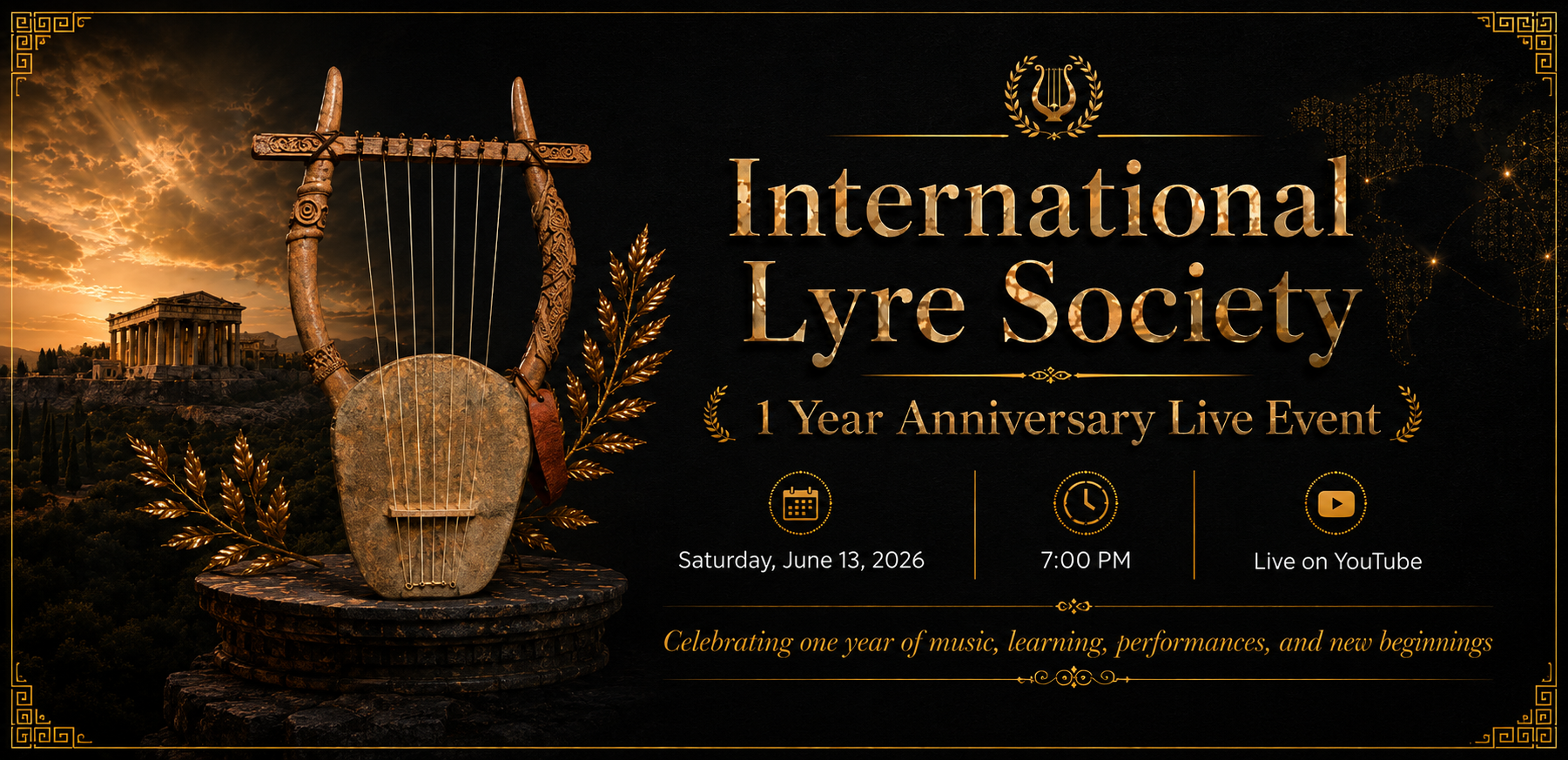
Celebrating One Year of the International Lyre Society

One year ago, the International Lyre Society began its journey with a simple but ambitious vision: to bring the ancient Greek seven-stringed lyre back into the hands, minds, and hearts of people around the world.
This Saturday, we invite you to celebrate with us as we mark the first anniversary of this remarkable journey!
Over the past year, together we have built an international community of students, musicians, researchers, instrument makers, educators, and enthusiasts united by a shared passion for the lyre. From online lessons and educational resources to international collaborations, public performances, and the launch of the ILS Academy, this first year has exceeded all expectations.
During this special live event, we will look back at some of the highlights of our first year, revisit memorable moments, share exciting news about current and upcoming projects, and present our plans for the future. We will also take a closer look at initiatives such as The Iliad at the Museum, The Lyre’s Dream, the growing activities of the ILS Academy, and the expanding international network of the Society.
Whether you have been with us from the beginning or have only recently discovered the lyre, this celebration is for you. It is an opportunity to meet fellow members of the community, learn more about our work, ask questions, and join us as we look ahead to the next chapter of this extraordinary adventure.
Most importantly, this event is our way of saying thank you. Thank you to our students, instructors, collaborators, supporters, donors, volunteers, and friends around the world who have helped transform an idea into a thriving international movement.
So bring your questions, your memories, your curiosity, and perhaps even your lyre, and join us for an evening of celebration, reflection, and exciting announcements.
We look forward to celebrating with you!
Saturday, 13 June 2026 7.00pm (Athens, Greece time)
Live on the International Lyre Society YouTube Channel. Click here for the link.
2nd Concerto for ancient Greek Lyre | 3rd Movement
Anecdote of the Month

Another story from Menelaos Pallantios…
During the entrance examinations for young children, Menelaos Pallantios asked one little boy- as was customary – to sing a song.
“I don’t know any songs,” the child replied with complete sincerity.
“Well then, recite a prayer for us,” Pallantios suggested.
“I don’t know any prayers either,” answered the boy.
“Then perhaps you can sing the national anthem,” proposed the Director.
“All right,” said the child, and immediately began:
“Allons enfants de la Patrie…”
The examination came to a rather unexpected conclusion.
The Reconstruction of the Ancient Greek Seven-Stringed Lyre
By George Nikas, luthier and researcher.

Research and Development
My original goal was to reconstruct an ancient Greek lyre for personal use, as I wished to study ancient Greek music. Having only a basic knowledge of instrument making, and using as references the instruments available on the Greek and international markets, I built my first lyre in 2011. The results were not particularly encouraging, both in terms of sound quality and in terms of whether an instrument that appeared to possess so many limitations could truly support virtuosic performance.
With these doubts in mind, I was confronted with a fundamental question: How is it possible that a musical instrument capable of supporting the highly sophisticated musical theory developed by the ancient Greeks, capable of rendering the finest compositions of its age, functioning as a central tool in compulsory education, and enjoying immense prestige as the symbolic instrument of the god of music, remain virtually unchanged for centuries—surely a sign of its perfection—and yet appear so limited in our own hands?
While visual representations provide us with considerable information regarding the ergonomics of the instrument, could its sound truly be the same as that heard two thousand years ago? We undoubtedly listen very differently today than people did in antiquity. Noise pollution, constant access to music through radio, television, the internet, and other media have created entirely different listening conditions. Consequently, our objective is no longer to reconstruct a museum artifact, but rather a fully functional musical instrument that preserves the ergonomics and symbolic forms of the ancient lyre while continuing to serve as one of the universal symbols of Western music.
Our long-term research into the ergonomics and acoustic qualities of the lyre was further enriched by the demanding performance method developed by Dr. Nikos Xanthoulis. The conclusions drawn from this combined effort ultimately led us to determine what kind of instrument is required in order to establish the lyre as a practical, high-level musical instrument.
Quality of Materials
Soundbox
After numerous experiments, we concluded that wood possesses significantly superior acoustic properties compared to an actual tortoise shell, which is essentially bone covered with keratin. Furthermore, the use of genuine shells would necessarily require shells obtained from deceased animals in various stages of decomposition, bringing with it a number of practical and ethical concerns. The use of plastic soundboxes was also rejected, as plastic lacks the acoustic qualities necessary for a high-quality musical instrument.
Why, then, did the ancient Greeks construct lyres from actual tortoise shells rather than from wood, a material they clearly possessed the knowledge and skill to work with? Furthermore, how do modern researchers—who are often neither instrument makers nor musicians—determine the ideal dimensions of a soundbox and, consequently, what constitutes a good sound, when every archaeological specimen recovered from excavations differs in size? This variation is entirely natural, since each tortoise used as a musical instrument belonged to a different species and age group.
Greece is home to three species of land tortoise: the Marginated Tortoise (Testudo marginata), Hermann’s Tortoise (Testudo hermanni), and the Greek Tortoise (Testudo graeca). In addition, there are two freshwater species, the Balkan Terrapin (Mauremys rivulata) and the European Pond Turtle. Finally, the Mediterranean Sea hosts three species of marine turtle: the Loggerhead Turtle (Caretta caretta), the Green Turtle, and the Leatherback Turtle.
Moreover, archaeological discoveries in Greece and Southern Italy that have brought to light the remains of ancient lyres have often led scholars to assume that all lyres were constructed exclusively from genuine tortoise shells. This conclusion may be misleading. If such a widespread instrument had always been made from tortoise shell, we would expect a much greater number of surviving examples. Furthermore, after thousands of years, bone is considerably more likely to survive than wood, which naturally decays and is absorbed into the soil.
If we further assume that even in Athens there was at least one lyre in every household—as musical education was an essential component of upbringing—it becomes difficult to imagine that local tortoise populations could have sustained such demand. It is therefore reasonable to suggest that wooden soundboxes painted to resemble tortoise shells may also have been used in antiquity. Indeed, many vase paintings depict remarkably similar shell shapes, almost as though only a single species and size of tortoise existed. This consistency may indicate that artists were depicting standardized wooden replicas rather than actual shells.
For these reasons, the use of wood as a soundbox became the only logical choice. Beyond the acoustic advantages discussed above, ecological considerations also played an important role, as we would not wish to harm animals for the construction of instruments. Likewise, we rejected the widespread use of plastics and synthetic resins commonly employed today in shell replicas. Such materials not only produce inferior acoustic results but also carry a significant environmental footprint.
At the same time, in order to remain faithful to the symbolic and philosophical dimensions of the instrument, we preserved the shape and visual appearance of both terrestrial and marine tortoise shells.
Arms and Crossbar
The woods used for these structural components are likewise sourced from trees native to Greece, including oak, walnut, olive, mulberry, and others. These species were selected primarily for their hardness, as the arms and crossbar form the structural framework of the instrument and must withstand the cumulative tension exerted by the strings, estimated at approximately 43 kilograms.
Chordotonion
The chordotonion is constructed from bronze or copper in order to enhance the overall vibration and acoustic response of the instrument. Beyond its practical role as the anchoring point for the strings, it serves a vital acoustic function by transmitting the vibrations of the strings directly to the soundbox.
Magadion
For the magadion, we employ woods of medium hardness. Excessively hard woods do not efficiently transmit the full spectrum of frequencies produced by the strings, while softer woods tend to dampen the sound and prevent the proper transfer of vibrations to the acoustic membrane.
Strings
To achieve the best possible acoustic results, we selected strings commonly used on other historical instruments. These were chosen for their tonal quality, durability, and resistance to wear caused by repeated contact with the plectrum. Aesthetic considerations were also important, as we sought strings resembling the natural colour of gut rather than conventional nylon strings.
Tuning Pegs
In an effort to improve the tuning mechanism of the instrument, we adopted pegs that rotate within holes drilled through the crossbar rather than the traditional rotating kollopes mounted on top of it. This system provides greater tuning stability. Boxwood, ebony, and rosewood are primarily used, as these materials contribute both to durability and to the efficient transmission of vibration and sound.
It should be noted that this type of tuning peg is not a modern invention. Similar examples have been discovered in excavations at Lefkada dating to the 7th century BCE, as well as in numerous finds from Pompeii*.
*Melini Robertro, Suoni sotto la Cenere, Ed. Flavius – Pompei 2008 page 41
Plectrum
Experiments with a wide range of materials led us to conclude that hard woods such as olive root and walnut, combined with bone, keratin (from goat, ram, or cattle horn), or enamel-like materials such as wild boar tusk, produce excellent results.
The finishing of the plectrum’s tip is particularly important, as it is the primary factor in preventing unwanted scraping noises on the strings. The size of the plectrum may vary according to the hand of the performer. In most cases, a slight curvature in its overall shape improves the tactile experience and comfort of the lyrist during performance.
Ergonomics and Dimensions
We studied a large number of vase paintings and visual representations in order to determine the relationship between the size of the instrument and the size of the human body, focusing primarily on the type of soundbox most frequently depicted in ancient iconography. This research led us to establish approximate dimensions for the instrument, after which extensive experimentation was carried out on the strings, including both their materials and their gauges.
The relationship between string length and thickness ultimately enabled us to determine the ideal overall dimensions of the instrument, ensuring that string tension remained as balanced and efficient as possible. The objective of these experiments was to achieve a level of tension that would allow each open string not only to produce a clear and stable fundamental pitch but also to support all of its natural harmonics with equal clarity.
The reason for pursuing this goal was our desire to integrate harmonics into the instrument’s practical repertoire rather than treating them merely as a sonic effect. Were we successful in achieving this objective?
I believe that the results vindicated our efforts, particularly in the series of lyres based on the form of the sea turtle shell. At this point, however, another factor enters the equation: the human element. No instrument plays itself. Ultimately, it is the musician’s skill—acquired through countless hours of study and practice—that reveals this remarkable point of equilibrium between the sound of the open strings and their harmonics.
Another essential aspect of the instrument’s ergonomics is the spacing between the strings. This is of great importance, as it directly affects the performer’s ability to execute chords comfortably and accurately. We have encountered reconstructed lyres in which the strings were placed so closely together that the fingers of the lyrist could barely fit between them, making it impossible to perform the traditional technique of psallein and limiting performance to simple strumming.
The dimensions of the soundbox constitute another crucial factor. Through extensive experimentation, we arrived at a number of fundamental models capable of producing a balanced and refined tonal character suitable for contemporary musical performance. For example, we tested both shallow and deep soundboxes, each of which produced markedly different acoustic results.
Deep soundboxes generated an excessively long sustain, resulting in a somewhat muddy tonal character, whereas very shallow soundboxes produced a dry and thin sound. Equally important is the thickness of the soundbox walls. Our goal has been to awaken and preserve the finest acoustic qualities of the woods we employ while simultaneously maintaining the richness of the lower and bass frequencies within the instrument’s overall tonal spectrum.
Soundboard
Finally, another decisive factor in achieving a high-quality sound is the soundboard, which in the case of the lyre consists of goat skin.
The selection of a suitable skin at the beginning of the process involves an element of chance, but the subsequent treatment of the skin in an alkaline ash solution to remove the hair is a highly specialized procedure requiring genuine tanning expertise rather than luck. Proper processing is essential in order to preserve the structural and acoustic integrity of the material.
The skin must remain free to vibrate if it is to produce sound effectively. For this reason, the use of adhesives is, in our view, highly undesirable. In our experiments, skins that had been glued directly onto the soundbox consistently demonstrated inferior acoustic performance compared to those mounted using more traditional methods.
Conclusion
In closing, we would like to emphasize that our research has been based upon the study of ancient vase paintings and iconographic sources, surviving written evidence preserved in ancient musical and theoretical texts, and extensive practical interaction with professional musicians, above all Dr. Nikos Xanthoulis.
Through this combination of historical research, experimentation, and performance practice, we have sought to create an instrument capable of meeting the demanding standards of contemporary professional musicians while preserving the philosophical, symbolic, and mythological character of the lyre.
At the same time, particular care has been taken to maintain the geometric proportions associated with the Golden Ratio, ensuring that the instrument remains faithful not only to its musical function but also to the aesthetic and intellectual principles that have accompanied it throughout its long history.
Basic Bibliography
West, M. L. (1999). Ancient Greek Music (S. Komninos, Trans.). Athens: Papadimas Publications.
Michailidis, S. (1989). The Encyclopedia of Ancient Greek Music. Athens: National Bank of Greece Cultural Foundation (MIET).Xanthoulis, N., Cleonides, Aristoxenus, & Anonymous Bellermann. (2005). Art of Music: Harmonic Introduction, Elements of Rhythm II, Art of Music (Introduction, translation, and commentary by Nikos Xanthoulis). Athens: Daidalos – I. Zacharopoulos Publications.
The Phrygian Harmonia

From Theory to Practice
The Phrygian harmonia is one of the most important, and at the same time one of the most debated, harmoniai of ancient Greek music. In theory, it is described as the octave species corresponding to the following sequence:
D – E – F – G – A – B – C – D
with the intervallic arrangement:
tone – semitone – tone – tone – tone – semitone – tone.
Yet already in antiquity, the concept of harmonia was not identified exclusively with a scale. Harmonia included ethos, the behaviour of the notes, the manner of performance, and ultimately the total musical experience.
In the Republic, Plato preserves only two harmoniai in his ideal city: the Dorian and the Phrygian. The first is associated with courage, stability, and self-mastery. The second is linked with energy, prayer, persuasion, and creative action. The Phrygian harmonia is not presented as ecstatic or Dionysian, but rather as a necessary complement to the Dorian.
Aristotle disagrees. In the Politics, he considers it paradoxical that Plato preserves the Phrygian harmonia while rejecting the aulos. In Aristotle’s view, the Phrygian harmonia and the aulos share the same nature: both are orgiastic, enthusiastic, and suitable for the arousal of strong emotions and catharsis. This disagreement is especially significant, because it reveals that even in the Classical period there was no single, fixed understanding of the character of the Phrygian harmonia.
The later tradition appears to stand closer to Aristotle. Pseudo-Plutarch associates the Phrygian harmonia with the aulos, Dionysian rites, and enthusiasm. Plato, by contrast, seems to offer a different reading of the same harmonia within the framework of musical education.
Modern scholars Stefan Hagel and Tosca Lynch have argued that Plato’s choice of the Dorian and Phrygian harmoniai may be connected with the practical realities of the lyre. According to this view, these two harmoniai constituted the most natural and functional systems for the traditional tuning of the lyre. This approach is particularly interesting, although it is based primarily on the theoretical reconstruction of ancient musical systems.
Aristoxenus shifts the focus from ethos to musical structure. The harmoniai become octave species and objects of systematic description. Ptolemy goes even further, incorporating them into a strictly mathematical and acoustic framework. In both cases, however, theory seems to move away from the living musical practice that probably characterized the great lyrists of the Archaic and Classical periods.
All these differences in the understanding of a musical system may very well be due to changes in the perception of ethos from one generation to the next. In other words, there is always evolution – a transformation both of the transmitter and of the receiver. This transformation arises from the different way in which each new generation perceives and interprets the available material.
On a practical level, however, the position of the mese is of particular interest. In the Dorian harmonia, the mese lies on A. If we consider the mese as a centre of sonic organization – a kind of tonic, and why not? – then the chord built upon it suggests a sound that the modern listener would describe as minor. By contrast, in the Phrygian harmonia, the mese lies on G. The chord formed on this note, G-B-D, creates the impression of a major centre.
Of course, the ancients did not speak of major and minor scales in the modern sense. Yet we do not know whether the acoustic experience of these different centres was entirely unrelated to the aesthetic distinctions described in the sources. Perhaps Plato’s preservation of the Dorian and Phrygian harmoniai was not accidental. Perhaps they represented the two great expressive poles of the music of his time.
The surviving musical monuments seem to support this line of thought. The opening phrases of the First Delphic Hymn strongly suggest the feeling of a minor centre, while the first measures of the Seikilos Epitaph convey a brightness that the modern ear perceives as closer to major modality. This is not proof, but it is a musical experience worthy of serious consideration.
My own engagement with the seven-stringed lyre has led me to an additional question. Modern research often links each harmonia with a specific tuning. This does not mean that we cannot, or should not, change the tuning of the instrument when this is necessary for the best possible acoustic result within the tessitura of a given piece. Practical experience, however, shows that the use of harmonics, variations in string tension, and the possibilities offered by technique allow movement between different genera, chroai, and harmoniai without the need for constant retuning.
If we are able to support this acoustically and technically today, it is difficult to imagine that the great lyrists of the 6th and 5th centuries BCE possessed less technical flexibility. Perhaps, then, the harmoniai were not simply different tunings, but different ways of organizing sound around specific centres and specific forms of ethos.
The Phrygian harmonia, as the ancient Greeks understood it in each historical period, continues to elude us. Perhaps, however, the most important task is not to reconstruct its sound with absolute certainty, but to understand why, for more than two thousand years, it remained a symbol of energy, movement, and musical transformation.
Every civilization and every age perceives this particular sequence of intervals in its own way. It is good that we too may enjoy it as we perceive it, while allowing the discussion of antiquity to remain, always, the occasion for wonderful inquiries.
Sources and References
Plato
Republic, Book III, 398e-399a.
In this passage, Socrates preserves the Dorian and Phrygian harmoniai and rejects the others.
“τὴν μὲν βιαίαν καὶ ἑκουσίαν ἐν πολέμοις καὶ πάσῃ ἀνάγκῃ πράξιν…”
(Dorian)
“τὴν δὲ ἐν εἰρήνῃ καὶ ἀναγκαστικὴν καὶ ἑκούσιον πράξιν…”
(Phrygian)
Aristotle
Politics, Book VIII, 1342a-1342b.
The famous passage reads:
“ἔχει γὰρ τὴν αὐτὴν δύναμιν ἡ φρυγιστὶ τῶν ἁρμονιῶν ἥνπερ αὐλὸς ἐν τοῖς ὀργάνοις”
and:
“ἄμφω γὰρ ὀργιαστικὰ καὶ παθητικά.”
Here lies Aristotle’s central objection to Plato.
Pseudo-Plutarch
On Music, especially chapters 14-17 and 30-32.
There, the Phrygian harmonia is associated with Olympus, the aulos, and the Dionysian tradition.
Aristoxenus
The Harmonic Elements do not provide an ethical description of the Phrygian harmonia. Their importance lies in the fact that they transform the concept of harmonia into:
an octave species,
an intervallic structure,
an acoustic object.
Key references: Harmonics I.23-29 (Da Rios); Harmonics II.37-38.
Ptolemy
Harmonics, Book II, chapters 10-11.
Stefan Hagel
Stefan Hagel, Ancient Greek Music: A New Technical History, Cambridge University Press, 2009.
See chapters 4-5, especially pp. 109-117.
Tosca Lynch
Tosca A. C. Lynch, “Why are only the Dorian and Phrygian Harmoniai accepted in Plato’s Kallipolis? Lyre versus Aulos,” in Lomiento & Meriani (eds.), Mousikē, 2016.
If you have not yet begun your journey with the lyre, we invite you to enroll in our free introductory course and become part of the growing International Lyre Society community.
The first step is open to all – the path continues as far as you wish to go.
Editorial Credits
Articles: Dr. Nikos Xanthoulis, G. Nikas
Copy Editing:
Dr. Evangelia Kopsalidou
Paul Amiel Stewart (English Version)
Editorial Coordination & Visual Curation:
Ilias Zervas
Published by the International Lyre Society
ILS Newsletter – June 2026 | Issue 04
ILS Newsletter – Ιούνιος 2026 | Τεύχος 04
Ένας Χρόνος International Lyre Society!
Πριν από έναν χρόνο, η International Lyre Society ξεκίνησε το ταξίδι της με ένα απλό αλλά φιλόδοξο όραμα: να φέρει την αρχαία ελληνική επτάχορδη λύρα ξανά στα χέρια, τη σκέψη και την καθημερινότητα ανθρώπων από όλο τον κόσμο.
Αυτό το Σάββατο, σας προσκαλούμε να γιορτάσουμε μαζί την πρώτη επέτειο αυτής της μοναδικής διαδρομής!
Μέσα σε μόλις έναν χρόνο, δημιουργήθηκε μια διεθνής κοινότητα λυριστών, μαθητών, μουσικών, ερευνητών, οργανοποιών, εκπαιδευτικών και φίλων της λύρας, ενωμένων από το κοινό πάθος για ένα από τα σημαντικότερα μουσικά σύμβολα του αρχαίου κόσμου. Από τα διαδικτυακά μαθήματα και τις εκπαιδευτικές δράσεις έως τις συναυλίες, τις διεθνείς συνεργασίες και την ίδρυση της ILS Academy, το πρώτο αυτό έτος ξεπέρασε κάθε προσδοκία.
Κατά τη διάρκεια της επετειακής εκδήλωσης θα θυμηθούμε μερικές από τις σημαντικότερες στιγμές της χρονιάς που πέρασε, θα μοιραστούμε νέα για τις τρέχουσες και τις επερχόμενες δράσεις μας και θα παρουσιάσουμε τα σχέδιά μας για το μέλλον. Θα αναφερθούμε σε πρωτοβουλίες όπως η σειρά εκδηλώσεων «Ιλιάδα στο Μουσείο», το διεθνές project The Lyre’s Dream, η ανάπτυξη της ILS Academy και το συνεχώς διευρυνόμενο διεθνές δίκτυο της Society.
Είτε μας ακολουθείτε από την πρώτη ημέρα είτε ανακαλύψατε πρόσφατα τον κόσμο της αρχαίας λύρας, αυτή η γιορτή είναι για εσάς. Είναι μια ευκαιρία να γνωριστούμε καλύτερα, να μοιραστούμε εμπειρίες, να συζητήσουμε ιδέες και να κοιτάξουμε μαζί το επόμενο κεφάλαιο αυτής της όμορφης προσπάθειας.
Πάνω απ’ όλα, η εκδήλωση αυτή είναι ο δικός μας τρόπος να πούμε ένα μεγάλο ευχαριστώ. Ευχαριστούμε τους μαθητές, τους διδάσκοντες, τους συνεργάτες, τους υποστηρικτές, τους δωρητές, τους εθελοντές και όλους τους φίλους της International Lyre Society που βοήθησαν ώστε ένα όνειρο να μετατραπεί σε μια ζωντανή διεθνή κοινότητα.
Σας περιμένουμε όλους για μια βραδιά γεμάτη αναμνήσεις, μουσική, νέες ανακοινώσεις και αισιοδοξία για το μέλλον.
Σάββατο 13 Ιουνίου 2026 7.00μ.μ. (ώρα Ελλάδος)
Ζωντανά στο κανάλι της International Lyre Society στο YouTube. Κάντε κλικ εδώ για τον σύνδεσμο του live.
2o Κοντσέρτο για Αρχαία Ελληνική Λύρα | Γ΄ Μέρος
Ανέκδοτο του Μήνα
Μια ακόμη ιστορία με τον Μενέλαο Παλλάντιο
Στις εισαγωγικές εξετάσεις των νηπίων ο Μενέλαος Παλλάντιος ζήτησε από ένα παιδάκι (κατά τα ειωθότα) να του πει ένα τραγουδάκι.
“Δεν ξέρω τραγούδια” λέει με υπέρμετρο αυθορμητισμό το παιδάκι.
“Ε πες μας μια προσευχούλα” επιμένει ο Παλλάντιος.
“Ούτε προσευχές ξέρω” απαντά ο μικρός.
“Τότε πες μας τον εθνικό ύμνο” του αντιπροτείνει ο διευθυντής.
“Εντάξει” λέει το αγοράκι και αρχίζει:
“Allons enfants de la patrie….”
Η εξέταση έλαβε απρόσμενη τροπή…
Η Ανακατασκευή της Αρχαιοελληνικής Επτάχορδης Λύρας
από τον Γιώργο Νίκα, οργανοποιό και ερευνητή.
Η έρευνα
Ο αρχικός μου στόχος ήταν η ανακατασκευή μιας αρχαίας Ελληνικής λύρας για προσωπική χρήση, καθώς ήθελα να μελετήσω την αρχαία Ελληνική μουσική. Έτσι με βασικές γνώσεις οργανοποιίας και ως πρότυπο τα όργανα που κυκλοφορούσαν στην Ελληνική και την παγκόσμια αγορά, κατασκεύασα την πρώτη μου λύρα το 2011 με όχι τόσο ενθαρρυντικά αποτελέσματα τόσο για τη ποιότητα του ήχου όσο και για το αν μπορεί ένα όργανο με τόσους περιορισμούς, που φαινόταν να έχει, να υποστηρίξει δεξιοτεχνικές εκτελέσεις. Έχοντας, λοιπόν, όλες αυτές τις αμφιβολίες στο μυαλό μου βρέθηκα μπροστά ένα μεγάλο ερώτημα: Πως γίνεται ένα μουσικό όργανο, που μπορεί να υποστηρίξει την ιδιαιτέρως ανεπτυγμένη μουσική θεωρία που είχαν αναπτύξει οι αρχαίοι Έλληνες, που μπορεί να αποδώσει τις κορυφαίες συνθέσεις της εποχής, που λειτουργεί ως εργαλείο της υποχρεωτικής εκπαίδευσης και που χαίρει τόσο μεγάλης εκτίμησης στην αρχαιότητα, καθώς είναι το όργανο-σύμβολο του θεού της μουσικής, και για πάρα πολλούς αιώνες να παραμένει απαράλλαχτο- δείγμα ότι πρόκειται για το τέλειο όργανο, στα δικά μας χέρια, να δείχνει τόσο περιορισμένο;
Σχετικά με την εργονομία του οργάνου είχαμε πολλές πληροφορίες από εικαστικές μαρτυρίες αλλά ο ήχος μπορεί να είναι αυτός που άκουγαν πριν 2000 χρόνια; Σίγουρα ακούμε πολύ διαφορετικά σήμερα απ’ ότι άκουγαν οι άνθρωποι τότε. Τα επίπεδα ηχορύπανσης, η καθημερινή πρόσβαση στην ακρόαση μουσικής μέσω του ραδιοφώνου, της τηλεόρασης του internet κλπ δημιουργούν άλλες συνθήκες για τα αυτιά μας. Επομένως ο στόχος πλέον είναι να ανακατασκευάσουμε μια λύρα όχι μουσειακή αλλά ένα πλήρως λειτουργικό όργανο που θα διατηρεί την εργονομία και τους συμβολικούς τύπους, ως παγκόσμιο σύμβολο της δυτικής μουσικής.
Την πολυετή έρευνα μας πάνω στην εργονομίας της λύρας και στη ποιότητα του ήχου της ήρθε να συμπληρώσει η απαιτητική μέθοδος του Νίκου Ξανθούλη. Τα συμπεράσματα από όλη αυτήν την προσπάθεια μας οδήγησαν να καταλήξουμε στο τι όργανο πρέπει να έχουμε στα χέρια μας ώστε να μπορέσουμε να αναδείξουμε τη λύρα ως χρηστικό όργανο υψηλού επιπέδου.
Ποιότητα υλικών
Αντηχείο
Μετά από πολλά πειράματα καταλήξαμε στο ότι το ξύλο έχει πολύ καλύτερη ηχητική σε σχέση με το πραγματικό καβούκι που στην ουσία είναι οστό καλυμμένο με κερατίνη. Από την άλλη είναι φυσικό να μην μπορούμε να χρησιμοποιήσουμε παρά καβούκια από νεκρά ζώα που βρίσκονται σε αποσύνθεση με όλα τα προβλήματα που προκύπτουν από αυτό. Η κατασκευή αντηχείων από πλαστικό απορρίφτηκε επίσης, αφού το πλαστικό δεν έχει ποιοτικές ακουστικές ιδιότητες.
Γιατί όμως οι αρχαίοι Έλληνες φτιάχναν τις λύρες από πραγματικό καβούκι και όχι από ξύλο, που προφανώς είχαν τις γνώσεις να το επεξεργαστούν; Επίσης οι σύγχρονοι ερευνητές (οι οποίοι συνήθως δεν είναι οργανοποιοί ή μουσικοί) πως ορίζουν το ιδανικό μέγεθος του αντηχείου άρα και τον καλό ήχο, αφού κάθε αρχαιολογικό εύρημα από τις ανασκαφές έχει διαφορετικό μέγεθος καβουκιού;- και λογικό είναι αφού η κάθε χελώνα που έγινε όργανο είχε διαφορετική ηλικία και ανήκε σε διαφορετικό είδος. (Στην Ελλάδα απαντώνται τρία είδη χερσαίων χελωνών: η Κρασπεδωτή (Testudo marginata), η Μεσογειακή (Testudo hermanni) και η Ελληνική (Testudo graeca). Επίσης, υπάρχουν και δύο είδη χελωνών γλυκού νερού, η Γραμμωτή νεροχελώνα (Mauremys rivulata) και η Στικτή νεροχελώνα. Τέλος, στη Μεσόγειο, και άρα και στις ελληνικές θάλασσες, συναντάμε τρία είδη θαλάσσιων χελωνών: την Caretta caretta, την Πράσινη Χελώνα και τη Δερματοχελώνα.)
Επιπλέον, οι αρχαιολογικές ανασκαφές σε Ελλάδα και Νότια Ιταλία που φέρνουν στο φως λείψανα λυρών οδηγούν λανθασμένα τους επιστήμονες στο συμπέρασμα ότι όλες οι λύρες ήταν φτιαγμένες μόνο από πραγματικό καβούκι χελώνας, αφενός γιατί θα είχαμε πολύ συχνότερα ευρήματα σε ένα τόσο διαδεδομένο όργανο του αρχαίου κόσμου, αφετέρου στο πέρασμα τόσων χιλιάδων ετών είναι πιθανότερο να βρεις το οστό παρά το ξύλο που σαπίζει και ¨χωνεύεται¨ από το χώμα. Επίσης αν υποθέσουμε ότι στην Αθήνα και μόνο υπήρχε τουλάχιστον μια λύρα σε κάθε σπίτι (καθώς είπαμε ότι ήταν υποχρεωτική στην εκπαίδευση) δεν θα είχε μείνει καμία χελώνα στα κοντινά βουνά της Αττικής. Λογικό είναι να καταλήξουμε στο συμπέρασμα ότι και στην αρχαιότητα χρησιμοποιούσαν ξύλινα αντηχεία ζωγραφισμένα ώστε να μοιάζουν με χελώνες (μάλιστα σε πολλές παραστάσεις σε αγγεία βλέπουμε ένα τύπο καβουκιού πανομοιότυπο, λες και υπάρχει μόνο ένα είδος και μέγεθος χελώνας, που υποθέτουμε ότι πρόκειται για ξύλινο αντίγραφο).
Επομένως, η χρήση του ξύλου ως αντηχείο ήταν μονόδρομος σε σχέση με το πραγματικό καβούκι και για τους λόγους που αναλύσαμε αλλά και από οικολογική ευαισθησία (δεν θα σκοτώναμε ένα ζώο!…), όπως και από κάθε είδους πλαστικά ή ρητινώδη υλικά που χρησιμοποιούνται κατά κόρον σήμερα για να κατασκευάσουν αντίγραφα καβουκιού, τα οποία εκτός από κακή ηχητική έχουν και καταστροφικό οικολογικό αποτύπωμα. Βέβαια, για να μείνουμε πιστοί στο συμβολικό – φιλοσοφικό κομμάτι του οργάνου διατηρήσαμε το σχήμα και την όψη των πραγματικών καβουκιών χερσαίας ή θαλάσσιας χελώνας.
Πήχεις – Ζυγός
Τα ξύλα που χρησιμοποιούμε για αυτά τα μέρη είναι και πάλι από ξύλο που φύεται στην Ελληνική γη όπως δρυς, καρυδιά, ελιά, μουριά κ.α. Ο λόγος της επιλογής των προαναφερθέντων ξύλων είναι η σκληρότητά τους, καθώς αυτά τα μέρη αποτελούν το σκελετό του οργάνου και δέχονται την τάση από τις χορδές η οποία υπολογίζεται περίπου στα 43Kg.
Χορδοτόνιον
Το χορδοτόνιο είναι από μπρούτζο ή χαλκό για να βοηθάει στην συνολική δόνηση και ακουστική του οργάνου. Ο ρόλος του χορδοτονίου εκτός από πρακτικός να δένουν οι χορδές πάνω του είναι τεράστιας ακουστικής σημασίας αφού από τη δόνηση της χορδής μεταφέρεται ο ήχος μέσω αυτού στο αντηχείο.
Μαγάδιον
Για το μαγάδιον χρησιμοποιούμε ξύλα μεσαίας σκληρότητας, καθώς τα πολύ σκληρά ξύλα δεν μεταδίδουν όλο το συχνοτικό εύρος που παράγουν οι χορδές. Από την άλλη τα μαλακά ξύλα έχουν τη τάση να φιμώνουν τον ήχο και να μην μεταδίδουν στην ακουστική μεμβράνη τις δονήσεις, όπως πρέπει.
Χορδές
Για την καλύτερη ακουστική των οργάνων επιλέχθηκαν χορδές που χρησιμοποιούνται σε άλλα ιστορικά όργανα τόσο για την ποιότητα του ήχου τους όσο και για τη διάρκεια ζωής τους καθώς και για την ιδιότητα που έχουν να μην παρουσιάζουν γρήγορα φθορές από τη χρήση του πλήκτρου. Επιπλέον το αισθητικό κομμάτι ήταν ένας σημαντικός παράγοντας καθώς θέλαμε χορδές που μοιάζουν στο φυσικό χρώμα του εντέρου και όχι απλές νάιλον χορδές.
Κόλλοπες
Θέλοντας να βελτιώσουμε τον μηχανισμό κουρδίσματος του οργάνου χρησιμοποιήσαμε κλειδιά που περιστρέφονται εντός των οπών του ζυγού και όχι περιστρεφόμενους πάνω στον ζυγό κόλλοπες, ώστε να έχουμε πιο σταθερό κούρδισμα. Χρησιμοποιούνται κυρίως πυξάρι, έβενος και τριανταφυλλιά τα οποία βοηθούν και στη σωστή μετάδοση της δόνησης και του ήχου.
Εξάλλου αυτού του τύπου τα κλειδιά δεν είναι μια νέα εφεύρεση αφού έχουν βρεθεί στη Λευκάδα σε ανασκαφή του 7ου π.Χ. αι. αλλά και πολλά επίσης στην Πομπηία.
* Melini Robertro, Suoni sotto la Cenere, Flavius, Pompei, 2008, σελ. 41.
Πλήκτρον
Τα πειράματα και οι δοκιμές σε διάφορα υλικά μας οδήγησαν στο συμπέρασμα ότι σκληρά ξύλα, όπως ρίζα ελιάς, καρυδιά κλπ σε συνδυασμό με οστό ή κερατίνη (κέρατα τράγου, κριού, αγελάδας) ή αδαμαντίνη (δόντι αγριογούρουνου) φέρουν ένα πολύ καλό αποτέλεσμα. Το φινίρισμα της αιχμής του πλήκτρου είναι πολύ σημαντικό καθώς είναι ο κυριότερος παράγοντας στο να αποφεύγονται τριξίματα στις χορδές. Το μέγεθος του πλήκτρου μπορεί να ποικίλει ανάλογα με το χέρι που το κρατά. Συνήθως μια ελαφριά καμπύλη στο συνολικό σχήμα βοηθάει στην αίσθηση που έχει ο λυριστής όταν παίζει.
Εργονομία-Διαστάσεις
Μελετήσαμε πολλά αγγεία ώστε να καταλήξουμε στη σχέση μεγέθους ανθρώπου-οργάνου κυρίως με τον τύπο του αντηχείου που βλέπουμε συχνότερα. Αυτό μας οδήγησε σε μια κατά προσέγγιση διάσταση του οργάνου και κατόπιν έγιναν πολλές δοκιμές στις χορδές τόσο στο υλικό όσο και στο πάχος τους. Η συνισταμένη του μήκους σε σχέση με το πάχος κάθε χορδής μας οδήγησε να καταλήξουμε στο ιδανικό συνολικό μήκος του οργάνου ώστε η τάση να είναι η καλύτερη δυνατή. Το ζητούμενο σε αυτές τις δοκιμές ήταν η τάση της χορδής να είναι τέτοια ώστε να μπορεί να υποστηρίξει ηχητικά το φθόγγο που παράγεται από την ανοιχτή χορδή το ίδιο καθαρά και σε όλες τις αρμονικές που παράγει η ίδια χορδή. Ο λόγος που θέλαμε να φτάσουμε σε αυτό το στόχο ήταν να εντάξουμε τις αρμονικές να είναι μέρος του ρεπερτορίου του οργάνου και όχι απλά ένα ηχητικό εφέ. Τα καταφέραμε;
Νομίζω το αποτέλεσμα μας δικαίωσε στη σειρά με τις λύρες που έχουν βασιστεί στο καλούπι της θαλάσσιας χελώνας. Βέβαια σε αυτό το σημείο μπαίνει πάλι στην εξίσωση ο ανθρώπινος παράγοντας. Κανένα όργανο δεν παίζει από μόνο του! Επομένως, η δεξιοτεχνία του μουσικού, την οποία αποκτά μέσα από πολλές ώρες μελέτης, είναι αυτή που αναδεικνύει αυτό το υπέροχο σημείο απόλυτης ισορροπίας του ήχου των ανοιχτών χορδών και των αρμονικών.
Ένα άλλο βασικό στοιχείο για την καλύτερη εργονομία του οργάνου είναι φυσικά η απόσταση των χορδών μεταξύ τους. Πολύ σημαντικό στοιχείο ώστε να μπορεί ο μουσικός να αποδίδει εύκολα τις συγχορδίες. Έχουμε συναντήσει ανακατασκευασμένες λύρες οι οποίες είχαν τόσο κοντά τις χορδές μεταξύ τους που δε χωρούσαν τα δάχτυλα του λυριστή με αποτέλεσμα να μη μπορεί να αποδώσει την τεχνική του ψάλλειν παρά μόνο του strumming.
Επιπλέον σημαντικός παράγοντας είναι οι διαστάσεις του αντηχείου. Κάναμε πολλές δοκιμές ώστε να καταλήξουμε σε κάποια βασικά μοντέλα που δίνουν ένα συνολικά ποιοτικό ηχητικό χαρακτήρα στο όργανο ώστε να ανταποκριθεί στη σύγχρονη εποχή. Για παράδειγμα δοκιμάσαμε και ρηχά αλλά και βαθιά μοντέλα αντηχείου που το καθένα μας έδινε άλλον ήχο. Η μεγάλη ουρά στα βαθιά αντηχεία μας έδωσε έναν ΄βρώμικο΄ ήχο αλλά και τα πολύ ρηχά από την άλλη μας δημιούργησαν ένα ξερό ήχο. Συμπληρωματικά σε αυτό λειτουργεί και το πάχος των τοιχωμάτων τους σκάφους καθώς θέλουμε να ξυπνήσουμε όλα τα ποιοτικά χαρακτηριστικά των ξύλων που χρησιμοποιούμε χωρίς όμως να χάσουμε το συχνοτικό φάσμα των μπάσων και χαμηλών συχνοτήτων.
Αρμονική Τράπεζα
Τέλος ένας άλλος σημαντικός παράγοντας για τον καλό ήχο είναι η αρμονική τράπεζα, που στη περίπτωση της λύρας είναι δέρμα αίγας. Η επιλογή του καλού δέρματος στο αρχικό στάδιο της διαδικασίας είναι ένας παράγοντας που βασίζεται στην τύχη αλλά στη συνέχεια η επεξεργασία του δέρματος στο σταχτόνερο, ώστε να αφαιρεθεί η τρίχα είναι ιδιαιτέρως σημαντική διαδικασία που χρειάζεται γνώση βυρσοδεψίας, και όχι τύχη, ώστε να μην αποδυναμώσουμε τη συμπεριφορά του δέρματος συνολικά. Το δέρμα πρέπει να είναι ελεύθερο να δονείται ώστε να παράγει ήχο και η χρήση συγκολλητικών ουσιών είναι, θα έλεγα, απαγορευτική, αφού στα πειράματά μας τα δέρματα που είχαμε κολλήσει στο ηχείο είχαν μέτρια ηχητική συμπεριφορά.
Κλείνοντας θα θέλαμε να τονίσουμε ότι η έρευνα μας στηρίχθηκε στη παρατήρηση απεικονίσεων σε αγγεία, σωζόμενες γραπτές πληροφορίες από μουσικά επιστημονικά κείμενα της εποχής2 καθώς και μακρά διαδραστική επαφή με επαγγελματίες μουσικούς και κυρίως με τον Νίκο Ξανθούλη, ώστε να καταφέρουμε να δημιουργήσουμε ένα όργανο που θα ανταποκρίνεται στις υψηλού επιπέδου απαιτήσεις των σύγχρονων επαγγελματιών μουσικών χωρίς η λύρα να χάνει το φιλοσοφικό – συμβολικό – μυθολογικό της χαρακτήρα και να διατηρήσει τις γεωμετρικές αναλογίες της χρυσής τομής.
Βασική Βιβλιογραφία:
West, M. L. (1999). Αρχαία Ελληνική Μουσική (Μετάφραση: Σ. Κομνηνός). Αθήνα: Εκδόσεις Παπαδήμα.
Μιχαηλίδης, Σ. (1989). Η Εγκυκλοπαίδεια της Αρχαίας Ελληνικής Μουσικής. Αθήνα: Μορφωτικό Ίδρυμα Εθνικής Τραπέζης (ΜΙΕΤ).
Ξανθούλης, Ν. / Κλεωνίδης / Αριστόξενος / Ανώνυμος Bellermann (2005). Τέχνη Μουσικής: Εισαγωγή Αρμονική, Ρυθμικών Στοιχείων Β’, Τέχνη Μουσικής (Εισαγωγή – Μετάφραση – Σχόλια: Νίκος Ξανθούλης). Αθήνα: Εκδόσεις Δαίδαλος – Ι. Ζαχαρόπουλος.
Η Φρύγια Αρμονία

Από τη θεωρία στην πράξη
Η φρύγια αρμονία αποτελεί μία από τις σημαντικότερες και ταυτόχρονα πιο αμφιλεγόμενες αρμονίες της αρχαίας ελληνικής μουσικής. Η θεωρία την περιγράφει ως το είδος οκτάβας που αντιστοιχεί στη διαδοχή:
ρε – μι – φα – σολ – λα – σι – ντο – ρε
με διάταξη διαστημάτων:
τόνος – ημιτόνιο – τόνος – τόνος – τόνος – ημιτόνιο – τόνος.
Ωστόσο, ήδη από την αρχαιότητα η έννοια της αρμονίας δεν ταυτιζόταν αποκλειστικά με μια κλίμακα. Η αρμονία περιλάμβανε το ήθος, τη συμπεριφορά των φθόγγων, τον τρόπο εκτέλεσης και τελικά τη συνολική μουσική εμπειρία.
Ο Πλάτων στην Πολιτεία διατηρεί μόνο δύο αρμονίες στην ιδανική πολιτεία του: τη δώρια και τη φρύγια. Η πρώτη συνδέεται με την ανδρεία, τη σταθερότητα και την αυτοκυριαρχία. Η δεύτερη με την ενεργητικότητα, την προσευχή, την πειθώ και τη δημιουργική δράση. Η φρύγια αρμονία δεν παρουσιάζεται ως έξαλλη ή διονυσιακή αλλά ως αναγκαίο συμπλήρωμα της δώριας.
Ο Αριστοτέλης διαφωνεί. Στα Πολιτικά θεωρεί παράδοξο ότι ο Πλάτων διατηρεί τη φρύγια αρμονία ενώ απορρίπτει τον αυλό. Κατά τη γνώμη του, η φρύγια αρμονία και ο αυλός έχουν κοινή φύση: είναι οργιαστικοί, ενθουσιαστικοί και κατάλληλοι για την πρόκληση ισχυρών συναισθημάτων και κάθαρσης. Η διαφωνία αυτή είναι ιδιαίτερα σημαντική, διότι αποκαλύπτει ότι ακόμη και στην κλασική εποχή δεν υπήρχε μία μοναδική αντίληψη για τον χαρακτήρα της φρύγιας αρμονίας.
Η μεταγενέστερη παράδοση φαίνεται να βρίσκεται πλησιέστερα στον Αριστοτέλη. Ο Ψευδο-Πλούταρχος συνδέει τη φρύγια αρμονία με τον αυλό, τις διονυσιακές τελετές και τον ενθουσιασμό. Αντίθετα, ο Πλάτων φαίνεται να επιχειρεί μια διαφορετική ανάγνωση της ίδιας αρμονίας μέσα στο πλαίσιο της μουσικής παιδείας.
Οι νεότεροι μελετητές Stefan Hagel και Tosca Lynch έχουν υποστηρίξει ότι η επιλογή της δωρίας και της φρύγιας αρμονίας από τον Πλάτωνα ενδέχεται να συνδέεται με τα πρακτικά δεδομένα της λύρας. Σύμφωνα με την άποψή τους, οι δύο αυτές αρμονίες αποτελούσαν τα πλέον φυσικά και λειτουργικά συστήματα για το παραδοσιακό λυρικό κούρδισμα. Η προσέγγιση αυτή είναι ιδιαίτερα ενδιαφέρουσα, αν και βασίζεται κυρίως στη θεωρητική ανακατασκευή των αρχαίων συστημάτων.
Ο Αριστόξενος μετατοπίζει το ενδιαφέρον από το ήθος προς τη μουσική δομή. Οι αρμονίες γίνονται πλέον είδη οκτάβας και αντικείμενα συστηματικής περιγραφής. Ο Πτολεμαίος θα προχωρήσει ακόμη περισσότερο, εντάσσοντάς τες σε ένα αυστηρά μαθηματικό και ακουστικό πλαίσιο. Ωστόσο, και στις δύο περιπτώσεις, η θεωρία φαίνεται να απομακρύνεται από τη ζωντανή μουσική πράξη που πιθανότατα χαρακτήριζε τους μεγάλους λυριστές των αρχαϊκών και κλασικών χρόνων.
Όλες αυτές οι διαφοροποιήσεις στην αντίληψη ενός συστήματος θα μπορούσαν κάλλιστα να οφείλονται στην διαφορά πρόσληψης του ήθους από γενεά σε γενεά. Με λίγα λόγια υπάρχει πάντα εξέλιξη – μεταβολή πομπού και δέκτη. Η μεταβολή αυτή οφείλεται στην διαφορετική αντίληψη των δεδομένων από κάθε νέα γενιά.
Στο πρακτικό επίπεδο όμως, ιδιαίτερο ενδιαφέρον παρουσιάζει η θέση της μέσης. Στη δώρια αρμονία η μέση βρίσκεται στο λα. Εάν θεωρήσουμε ότι η μέση λειτουργεί ως κέντρο οργανώσεως του ήχου, ένα είδος τονικής (και γιατί όχι;) τότε η συγχορδία που δημιουργείται πάνω από αυτήν παραπέμπει σε ένα άκουσμα που ο σύγχρονος ακροατής θα χαρακτήριζε ελάσσονα. Αντίθετα, στη φρύγια αρμονία η μέση βρίσκεται στο σολ. Η συγχορδία που σχηματίζεται πάνω από αυτόν τον φθόγγο (σολ–σι–ρε) δημιουργεί την αίσθηση ενός μείζονος κέντρου.
Βεβαίως, οι αρχαίοι δεν μιλούν για μείζονες και ελάσσονες κλίμακες με τη νεότερη έννοια. Ωστόσο, δεν γνωρίζουμε αν η ακουστική εμπειρία των διαφορετικών αυτών κέντρων ήταν εντελώς ξένη προς τις αισθητικές διακρίσεις που περιγράφουν οι πηγές. Ίσως μάλιστα η διατήρηση της δώριας και της φρύγιας αρμονίας από τον Πλάτωνα να μην είναι τυχαία. Ίσως να αποτελούσαν τους δύο μεγάλους εκφραστικούς πόλους της μουσικής της εποχής του.
Τα σωζόμενα μουσικά μνημεία φαίνεται να ενισχύουν αυτή τη σκέψη. Οι πρώτες φράσεις του Α΄ Δελφικού Ύμνου δημιουργούν έντονα την αίσθηση ενός ελάσσονος κέντρου, ενώ τα πρώτα μέτρα του Επιταφίου του Σεικίλου αποπνέουν μια φωτεινότητα που το σύγχρονο αυτί αντιλαμβάνεται ως πλησιέστερη στη μείζονα τροπικότητα. Δεν πρόκειται για απόδειξη, αλλά για μια μουσική εμπειρία που αξίζει να ληφθεί σοβαρά υπόψη.
Η προσωπική μου ενασχόληση με την επτάχορδη λύρα με έχει οδηγήσει σε έναν επιπλέον προβληματισμό. Η σύγχρονη έρευνα συχνά συνδέει κάθε αρμονία με ένα συγκεκριμένο κούρδισμα. Αυτό δεν σημαίνει πως δεν μπορούμε ή δεν οφείλουμε να αλλάξουμε το κούρδισμα του οργάνου αν αυτό είναι αναγκαίο για την καλύτερη ηχητική απόδοση του οργάνου στην εκάστοτε τεσιτούρα του κομματιού. Η πρακτική εμπειρία όμως δείχνει ότι η χρήση των αρμονικών, η μεταβολή της τάσης των χορδών και οι δυνατότητες της τεχνικής επιτρέπουν την κίνηση ανάμεσα σε διαφορετικά γένη, χρόες και αρμονίες χωρίς την ανάγκη συνεχούς αλλαγής χορδίσματος.
Αν αυτό μπορούμε να το υποστηρίξουμε ακουστικά και «παικτικά» σήμερα, είναι δύσκολο να φανταστούμε ότι οι μεγάλοι λυριστές του 6ου και του 5ου αιώνα π.Χ. διέθεταν μικρότερη τεχνική ευχέρεια. Ίσως, λοιπόν, οι αρμονίες να μην ήταν απλώς διαφορετικά κουρδίσματα αλλά διαφορετικοί τρόποι οργάνωσης του ήχου γύρω από συγκεκριμένα κέντρα και συγκεκριμένα ήθη.
Η φρύγια αρμονία, όπως την αντιλαμβάνονταν οι αρχαίοι Έλληνες (σε κάθε ιστορική περίοδο) εξακολουθεί να μας διαφεύγει. Ίσως όμως το σημαντικότερο δεν είναι να ανακατασκευάσουμε με απόλυτη βεβαιότητα τον ήχο της, αλλά να κατανοήσουμε γιατί επί περισσότερους από δύο χιλιάδες χρόνια παρέμεινε σύμβολο ενέργειας, κίνησης και μουσικής μεταμόρφωσης. Ο κάθε πολιτισμός, η κάθε εποχή αντιλαμβάνεται αυτήν την συγκεκριμένη σειρά διαστημάτων με τον δικό του τρόπο. Καλό είναι να την απολαμβάνουμε και εμείς όπως το αντιλαμβανόμαστε και η συζήτηση για την αρχαιότητα να είναι πάντα η αφορμή για υπέροχες αναζητήσεις.
Πλάτων
Πολιτεία, Γ΄ βιβλίο, 398e–399a.
Εκεί ο Σωκράτης διατηρεί τη Δωριστί και τη Φρυγιστί και απορρίπτει τις υπόλοιπες αρμονίες.
«τὴν μὲν βιαίαν καὶ ἑκουσίαν ἐν πολέμοις καὶ πάσῃ ἀνάγκῃ πράξιν… (Δωριστί)
τὴν δὲ ἐν εἰρήνῃ καὶ ἀναγκαστικὴν καὶ ἑκούσιον πράξιν… (Φρυγιστί)»
Αριστοτέλης
Πολιτικά, Η΄ βιβλίο, 1342a–1342b.
Το περίφημο χωρίο: «ἔχει γὰρ τὴν αὐτὴν δύναμιν ἡ φρυγιστὶ τῶν ἁρμονιῶν ἥνπερ αὐλὸς ἐν τοῖς ὀργάνοις» και «ἄμφω γὰρ ὀργιαστικὰ καὶ παθητικά.»
Εδώ βρίσκεται όλη η ένσταση του Αριστοτέλη προς τον Πλάτωνα.
Ψευδο-Πλούταρχος
Περὶ Μουσικῆς, κυρίως κεφάλαια 14–17 και 30–32.
Εκεί συνδέεται η φρύγια αρμονία: με τον Όλυμπο, με τον αυλό, με τη διονυσιακή παράδοση.
Αριστόξενος
Τα Ἁρμονικὰ Στοιχεῖα δεν δίνουν ηθική περιγραφή της φρύγιας αρμονίας.
Το σημαντικό είναι ότι μετατρέπουν την έννοια της αρμονίας σε:
εἶδος διὰ πασῶν, δομή διαστημάτων, ακουστικό αντικείμενο.
Βασικές αναφορές: Harmonics I.23–29 (Da Rios) Harmonics II.37–38
Πτολεμαίος
Ἁρμονικά, Βιβλίο Β΄, κεφ. 10–11.
Stefan Hagel
Stefan Hagel, Ancient Greek Music: A New Technical History, Cambridge University Press, 2009.
κεφάλαια 4–5 και πιο ειδικά σ. 109–117.
Tosca Lynch
Tosca A.C. Lynch,
“Why are only the Dorian and Phrygian Harmoniai accepted in Plato’s Kallipolis? Lyre versus Aulos”,
στο Lomiento & Meriani (eds.), Mousikē, 2016.
Αν δεν έχετε ακόμη ξεκινήσει το ταξίδι σας με τη λύρα, σας προσκαλούμε να εγγραφείτε στο δωρεάν εισαγωγικό μας μάθημα και να γίνετε μέρος της διαρκώς αναπτυσσόμενης κοινότητας της International Lyre Society.
Το πρώτο βήμα είναι ανοιχτό σε όλους – η πορεία συνεχίζεται όσο μακριά επιθυμείτε να φτάσετε.
Συντακτική Ταυτότητα
Άρθρα: Δρ. Νίκος Ξανθούλης, Γ. Νίκας
Επιμέλεια Κειμένων:
Δρ. Ευαγγελία Κοψαλίδου
Paul Amiel Stewart (Αγγλική έκδοση)
Συντονισμός Έκδοσης & Οπτική Επιμέλεια:
Ηλίας Ζέρβας
Έκδοση: International Lyre Society