
ILS Newsletter – July 2026 | Issue 05
This newsletter is available in English and Greek.
Scroll down or click here for the Greek version.
From Thrace to Delphi: The Living Tradition of the Ancient Lyre

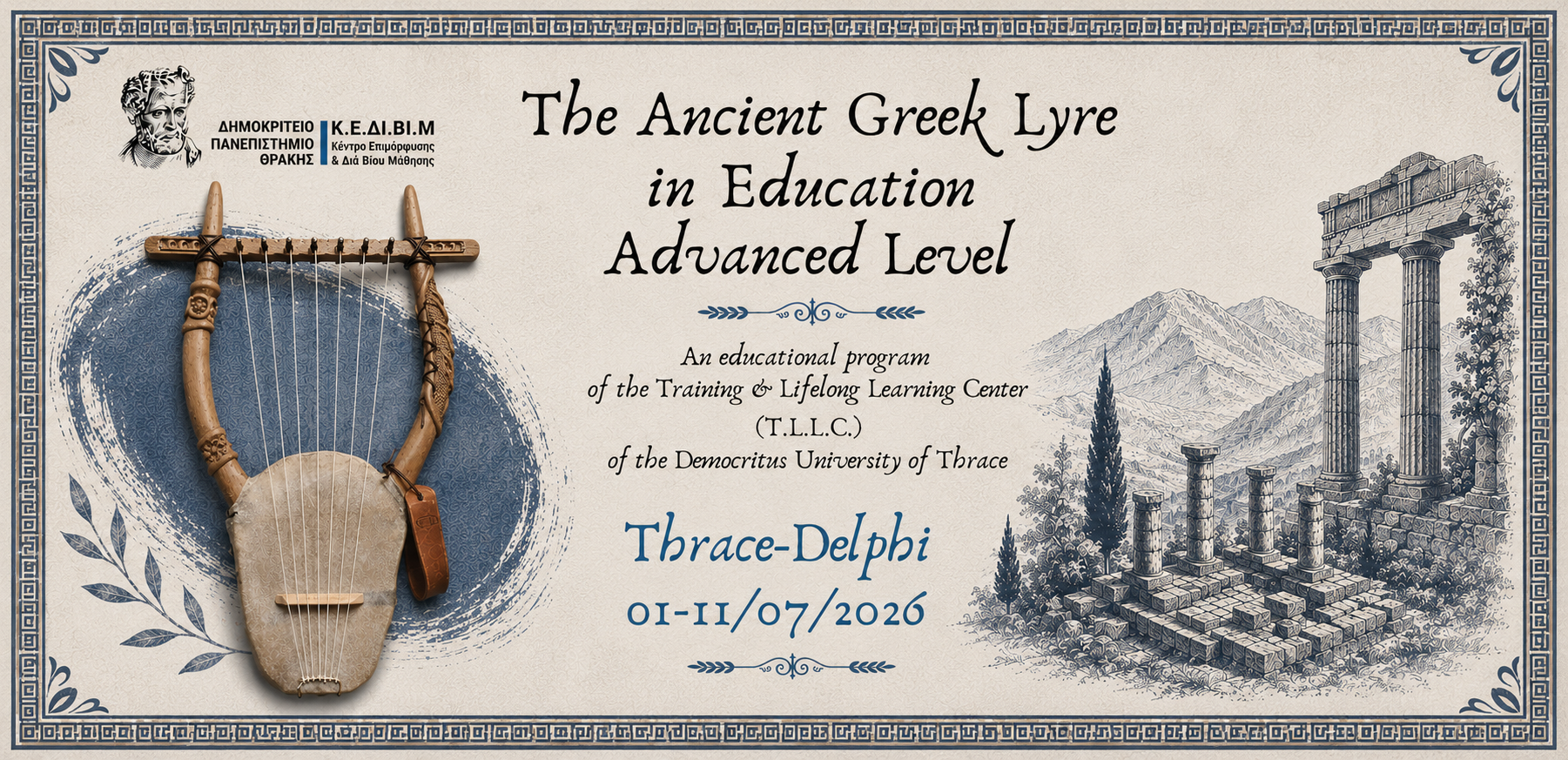
The first official educational programme in Ancient Greek Seven-Stringed Lyre Studies offered by the Centre for Lifelong Learning of Democritus University of Thrace is concluding its third consecutive year with three distinctive musical events in Komotini, Maroneia, and Delphi. Instructors and students present works for lyre and lyric performance, connecting musical practice with historical sites of profound cultural significance.
A highlight of this year’s programme will be the performance of the First Delphic Hymn to Apollo within the archaeological sanctuary of Delphi, reaffirming that the ancient lyre continues to serve as a living medium of artistic expression, education, and cultural revival.
Promnesia by Giorgos Tabakis
Anecdote of the Month

Anecdote of the month
Once, the great Maestro Andreas Paridis was rehearsing with a singer whose intonation left much to be desired. The rehearsal went on, and the maestro sighed and puffed in growing frustration. At one point, he could no longer contain himself and said:
“I look for you on the white keys, and I can’t find you. I look for you on the black keys, and I can’t find you there either. Where on earth are you singing – in the cracks between them?”
The Musician’s Journey

Imagine that you are at home. It is a beautiful house—familiar, comforting, and safe. You know every corner of it. You know where you belong.
This is the tonic.
In the Dorian harmonia, your home is A minor.
At some point, however, you open the door and step outside. There is no reason to remain inside forever. The world is vast, and it invites you to discover it.
So you arrive at D minor.
You are not lost. You are simply farther away from your center. You encounter new landscapes, hear new sounds, and begin to discover things you never knew before.
As you continue, the journey becomes ever more fascinating, yet also more demanding. The roads grow more difficult, and you begin to wonder which direction to take.
Then you arrive at G major.
Here lies the tension of the story. It is not a bad place. It is the point at which the adventure reaches its climax. It is the moment when you realize that in order to find yourself, you must first seek yourself.
G whispers to you:
“You have travelled well. But where do you truly belong?”
And then you remember the path home.
You return to A minor.
Your home is exactly where you left it. Yet it is no longer the same. The walls are the same. The door is the same. The room is the same.
But you have changed.
Now you know the world beyond your home. You know distance, uncertainty, adventure, and return. That is why the final A minor always sounds more beautiful than the first- not because the chord itself has changed, but because you have changed.
Perhaps herein lies a small secret – not only of music, but of life itself.
Many people seek peace by remaining still. Yet true peace is not born of immobility. It is born of the journey.
The bird returns to its nest.
The river returns to the sea.
The human being returns to oneself.
But neither the bird, nor the river, nor the human being is exactly the same as before.
Wisdom does not lie in never leaving one’s home. It lies in departing, discovering the world, and one day being able to return carrying within oneself all that has been learned.
So it is in music.
The tonic is home.
The subdominant is the road.
The dominant is the great trial.
And the return to the tonic is the moment when one understands that home had always been there. Only now is it seen with different eyes.
Perhaps this is why the ancient sages expressed different ideas that ultimately spoke of the same mystery.
Heraclitus reminds us that everything flows and everything moves.
Hegel teaches us that progress is born through opposition and contradiction.
Parmenides tells us that beneath all change there exists a deeper unity.
And music seems to vindicate them all.
For every beautiful melody begins at a point, moves away, wanders, encounters difficulties, and eventually returns to where it began.
Then we understand that the journey and the destination were never two separate things.
They were one.
The Lydian Harmonia: A Historical Approach to Its Ethos

The Lydian harmonia constitutes one of the most intriguing and enduring concepts in the history of Western musical thought. From Ancient Greece to the Renaissance, its name survives, yet its ethos and musical function undergo significant transformations in accordance with the aesthetic values of each period. Tracing this evolution reveals not merely the history of a musical mode, but also the history of musical expression itself.
The earliest references associate the Lydian with Lydia and, more broadly, with the cultural sphere of Asia Minor. For the Greeks, these musical traditions represented a world of refinement, emotional sensitivity, and artistic sophistication. Although precise descriptions of their musical form have not survived, the Lydian appears to have been associated, already in the Archaic period, with an ethos distinct from the austerity traditionally attributed to the Dorian.
In the Classical period, we encounter the first explicit philosophical evaluation of the Lydian harmonia. In the Republic(398e–399a), Plato refers to the chalara lydisti and syntonolydisti harmonies, which he considers unsuitable for the education of the citizens of his ideal state. He associates them with lamentation, mourning, softness, and emotional relaxation. Within the Platonic system of values, the Lydian does not embody the courageous and self-disciplined ethos that he wishes to cultivate among the guardians of the city.
To the modern listener, the notion that a major scale may convey a mournful character can appear paradoxical. Yet Handel’s aria Lascia ch’io pianga offers a compelling example. It is perhaps one of the most tragic pieces ever composed, and yet it is written in F major.
Aristotle, by contrast, presents an entirely different perspective in the Politics (1342b). He characterizes the Lydian as malista tōn harmoniōn paideutikē—“the most educational of the harmonies.” He attributes to it qualities of gentleness, balance, and decorum. This shift is remarkable: within the span of only a few decades, the same harmonia is portrayed at one moment as mournful and effeminate, and at another as mild and pedagogically beneficial. Such divergence suggests that musical ethos was not regarded as an objective property inherent in a scale, but rather as a product of musical practice and aesthetic perception.
With Aristoxenus, the discussion moves away from ethical evaluation toward musical analysis. Attention is redirected to the relationships between pitches, genera, and the structural organization of the harmoniai. The Lydian thus ceases to be primarily a philosophical subject and becomes integrated into a systematic theoretical framework.
The historical continuity of the Lydian becomes particularly fascinating when examined through the lens of performance practice. As transmitted by ancient authors, the Lydian harmonia corresponds to the arrangement extending from C to C. On the seven-stringed lyre, however, the central string (mese) occupies the position of F. The mese is not simply another pitch within the system; it constitutes the axis around which musical thought is organized and serves as the principal point of reference in performance.
From this perspective, the Lydian harmonia is not experienced merely as a scale spanning C to C, but rather as a musical space whose center of gravity lies on F. This observation acquires particular significance when compared with the medieval Lydian mode.
During the Middle Ages, the Lydian mode is defined by F as its finalis and develops around this pitch. A characteristic feature of the mode is the presence of the F–B interval, which generates the tension of the tritone. Medieval practice frequently mitigated this tension through the use of B-flat (B molle), without, however, fundamentally altering the modal identity of the Lydian.
The same situation persists during the Renaissance. The Lydian remains theoretically present, while performance practice adapts its intervals according to the aesthetic demands of the period. This serves as a reminder that the ethos of a mode is determined not solely by its theoretical description, but also by the manner in which it lives within musical practice.
The journey of the Lydian harmonia from Antiquity to the Renaissance demonstrates that musical modes are not static theoretical constructs. Rather, they are continuously transformed through performance, aesthetic experience, and cultural use. In the case of the Lydian, reconsidering the role of the mese on the seven-stringed lyre offers a fresh perspective for understanding ancient musical ethos and allows us to formulate a productive hypothesis: that the affinity between the ancient Lydian harmonia and the medieval Lydian mode stems not only from their intervallic structure, but more fundamentally from the function of a shared musical center – F.
Viewed from this perspective, the revival of the ancient lyre constitutes more than an attempt to reconstruct an instrument or a repertoire. It also represents a laboratory for reapproaching the very musical ethos described by ancient sources.
If you have not yet begun your journey with the lyre, we invite you to enroll in our free introductory course and become part of the growing International Lyre Society community.
The first step is open to all – the path continues as far as you wish to go.
Editorial Credits
Articles: Dr. Nikos Xanthoulis
Copy Editing:
Dr. Evangelia Kopsalidou
Paul Amiel Stewart (English Version)
Editorial Coordination & Visual Curation:
Ilias Zervas
Published by the International Lyre Society
ILS Newsletter – July 2026 | Issue 05
ILS Newsletter – Ιούλιος 2026 | Τεύχος 05
Τρεις Συναυλίες, Ένα Ταξίδι: Η Λύρα από τη Θράκη στους Δελφούς
Το πρώτο επίσημο πρόγραμμα διδασκαλίας της Αρχαίας Ελληνικής Επτάχορδης Λύρας του Κ.Ε.ΔΙ.ΒΙ.Μ. του Δημοκριτείου Πανεπιστημίου Θράκης ολοκλήρωνει για τρίτη συνεχή χρονιά τον κύκλο του με τρεις ξεχωριστές μουσικές εκδηλώσεις στην Κομοτηνή, τη Μαρώνεια και τους Δελφούς. Εκπαιδευτές και εκπαιδευόμενοι παρουσιάζουν έργα για λύρα και λυρωδίες, συνδέοντας τη μουσική πράξη με ιστορικούς τόπους ιδιαίτερου συμβολισμού.
Ιδιαίτερη στιγμή της φετινής διοργάνωσης θα αποτελέσει η ερμηνεία του Α΄ Δελφικού Ύμνου στον Απόλλωνα στον αρχαιολογικό χώρο των Δελφών, επιβεβαιώνοντας ότι η αρχαία λύρα εξακολουθεί να αποτελεί ένα ζωντανό μέσο καλλιτεχνικής δημιουργίας, παιδείας και πολιτισμικής αναβίωσης.
Προμνησία από τον Γιώργο Ταμπάκη
Ανέκδοτο του Μήνα
Ανέκδοτο του μήνα
Κάποτε ο μεγάλος Μαέστρος Ανδρέας Παρίδης έκανε πρόβα με μια τραγουδίστρια η οποία δεν ήταν και πολύ σωστή τονικά. Η πρόβα προχωρούσε και ο μαέστρος φυσούσε και ξεφυσούσε. Σε μια στιγμή δεν άντεξε και της είπε:
«Σε ψάχνω στα άσπρα πλήκτρα, δεν σε βρίσκω, σε ψάχνω στα μαύρα, ούτε εκεί σε βρίσκω. Μα πού στο καλό τραγουδάς, στις χαραμάδες»;
Το ταξίδι του Μουσικού

Φαντάσου ότι βρίσκεσαι στο σπίτι σου. Είναι ένα όμορφο σπίτι, γνώριμο και ασφαλές. Ξέρεις κάθε γωνιά του. Ξέρεις πού ανήκεις.
Αυτό είναι η τονική.
Στη Δωρική αρμονία, το σπίτι σου είναι η Λα μινόρε.
Κάποια στιγμή όμως ανοίγεις την πόρτα και βγαίνεις έξω. Δεν υπάρχει κανένας λόγος να μείνεις για πάντα μέσα στο σπίτι. Ο κόσμος είναι μεγάλος και σε καλεί να τον γνωρίσεις.
Έτσι φτάνεις στη Ρε μινόρε.
Δεν είσαι χαμένος. Απλώς βρίσκεσαι πιο μακριά από το κέντρο σου. Βλέπεις νέα τοπία, ακούς νέους ήχους και αρχίζεις να ανακαλύπτεις πράγματα που δεν γνώριζες.
Όσο προχωράς, το ταξίδι γίνεται πιο συναρπαστικό αλλά και πιο απαιτητικό. Οι δρόμοι γίνονται πιο δύσκολοι και αρχίζεις να αναρωτιέσαι προς τα πού πρέπει να πας.
Τότε φτάνεις στη Σολ μείζονα.
Εδώ βρίσκεται η ένταση της ιστορίας. Δεν είναι ένα κακό μέρος. Είναι το σημείο όπου η περιπέτεια κορυφώνεται. Είναι η στιγμή που καταλαβαίνεις ότι για να βρεις τον εαυτό σου πρέπει πρώτα να τον αναζητήσεις.
Η Σολ σου ψιθυρίζει: “Ωραία ταξίδεψες. Τώρα όμως πού ανήκεις;” Και τότε θυμάσαι τον δρόμο της επιστροφής.
Επιστρέφεις στη Λα μινόρε.
Το σπίτι είναι ακριβώς εκεί που το άφησες. Κι όμως δεν είναι το ίδιο. Οι τοίχοι είναι οι ίδιοι. Η πόρτα είναι η ίδια. Το δωμάτιο είναι το ίδιο. Εσύ όμως έχεις αλλάξει.
Τώρα γνωρίζεις τον κόσμο που βρίσκεται έξω από το σπίτι σου. Γνωρίζεις την απόσταση, την αμφιβολία, την περιπέτεια και την επιστροφή. Γι’ αυτό η τελευταία Λα μινόρε ακούγεται πάντα πιο όμορφη από την πρώτη. Όχι επειδή άλλαξε η συγχορδία.
Αλλά επειδή άλλαξες εσύ.
Και ίσως εδώ κρύβεται ένα μικρό μυστικό, όχι μόνο της μουσικής αλλά και της ζωής.
Πολλοί άνθρωποι αναζητούν την ηρεμία μένοντας ακίνητοι. Όμως η αληθινή ηρεμία δεν γεννιέται από την ακινησία. Γεννιέται από το ταξίδι. Το πουλί επιστρέφει στη φωλιά του.
Το ποτάμι επιστρέφει στη θάλασσα.
Ο άνθρωπος επιστρέφει στον εαυτό του.
Αλλά ούτε το πουλί, ούτε το ποτάμι, ούτε ο άνθρωπος είναι ακριβώς τα ίδια όπως πριν.
Η σοφία δεν βρίσκεται στο να μη φύγεις ποτέ από το σπίτι σου. Βρίσκεται στο να φύγεις, να γνωρίσεις τον κόσμο και να μπορέσεις κάποτε να επιστρέψεις κρατώντας μέσα σου όσα έμαθες. Έτσι συμβαίνει και στη μουσική. Η τονική είναι το σπίτι. Η υποδεσπόζουσα είναι ο δρόμος. Η δεσπόζουσα είναι η μεγάλη δοκιμασία. Και η επιστροφή στην τονική είναι η στιγμή που καταλαβαίνεις ότι το σπίτι βρίσκονταν πάντοτε εκεί. Μόνο που τώρα το βλέπεις με άλλα μάτια. Ίσως γι’ αυτό οι αρχαίοι σοφοί έλεγαν διαφορετικά πράγματα που τελικά μιλούσαν για το ίδιο μυστήριο.
Ο Ηράκλειτος μας θυμίζει ότι όλα ρέουν και όλα κινούνται.
Ο Χέγκελ ότι η πρόοδος γεννιέται μέσα από τις αντιθέσεις.
Ο Παρμενίδης ότι πίσω από όλες τις αλλαγές υπάρχει μια βαθύτερη ενότητα.
Και η μουσική φαίνεται να τους δικαιώνει όλους. Γιατί κάθε όμορφη μελωδία ξεκινά από ένα σημείο, απομακρύνεται, περιπλανιέται, συναντά δυσκολίες και επιστρέφει πάλι εκεί απ’ όπου ξεκίνησε. Τότε καταλαβαίνουμε ότι το ταξίδι και ο προορισμός δεν ήταν δύο διαφορετικά πράγματα.
Ήταν ένα.
Η Λυδική Αρμονία: Μια Ιστορική Προσέγγιση του Ήθους της

Η λυδική αρμονία αποτελεί μία από τις πιο ενδιαφέρουσες και διαχρονικές έννοιες της δυτικής μουσικής σκέψης. Από την αρχαία Ελλάδα έως την Αναγέννηση, το όνομά της επιβιώνει, όμως το ήθος και η μουσική της λειτουργία μεταβάλλονται ανάλογα με τις αισθητικές αντιλήψεις κάθε εποχής. Η παρακολούθηση αυτής της εξέλιξης αποκαλύπτει όχι μόνο την ιστορία ενός τρόπου, αλλά και την ιστορία της ίδιας της μουσικής έκφρασης.
Οι αρχαιότερες αναφορές συνδέουν τη λυδική με τη Λυδία και γενικότερα με τον πολιτισμικό χώρο της Μικράς Ασίας. Για τους Έλληνες, οι μουσικές αυτές παραδόσεις αντιπροσώπευαν έναν κόσμο εκλέπτυνσης, συναισθηματικής ευαισθησίας και καλλιτεχνικής πολυτέλειας. Αν και δεν διαθέτουμε ακριβείς περιγραφές της μουσικής τους μορφής, η λυδική φαίνεται ότι ήδη από την αρχαϊκή εποχή συνδεόταν με ένα ήθος διαφορετικό από τη δωρική αυστηρότητα.
Στην κλασική εποχή συναντούμε την πρώτη σαφή φιλοσοφική αξιολόγηση της λυδικής αρμονίας. Στην Πολιτεία (398e–399a), ο Πλάτων αναφέρεται στις «χαλαραί λυδιστί» και «συντονολυδιστί» αρμονίες, τις οποίες θεωρεί ακατάλληλες για την αγωγή των πολιτών της ιδανικής πολιτείας. Τις συνδέει με θρήνους, οδυρμούς, μαλθακότητα και ψυχική χαλάρωση. Στο πλατωνικό σύστημα αξιών, η λυδική δεν υπηρετεί το ανδρείο και εγκρατές ήθος που επιθυμεί για τους φύλακες της πόλης. Στην απορία του σύγχρονου ακροατή αν μια μείζονα κλίμακα μπορεί να είναι θρηνητική το παράδειγμα είναι η άρια “Lascia ch’io pianga” του Χαίντελ. Ίσως ένα από τα πιο τραγικά κομμάτια που έχουν γραφτεί και αυτό είναι στη φα μείζονα.
Ο Αριστοτέλης, αντίθετα, στα Πολιτικά (1342b), διατυπώνει μια εντελώς διαφορετική άποψη. Χαρακτηρίζει τη λυδική ως «μάλιστα τῶν ἁρμονιῶν παιδευτική», δηλαδή ως την καταλληλότερη για εκπαιδευτική χρήση. Της αποδίδει ηπιότητα, ισορροπία και ευκοσμία. Η μεταβολή αυτή είναι εντυπωσιακή: μέσα σε λίγες δεκαετίες η ίδια αρμονία εμφανίζεται άλλοτε ως θρηνητική και μαλθακή και άλλοτε ως ήπια και παιδευτική. Η διαφορά αυτή υποδηλώνει ότι το μουσικό ήθος δεν ήταν μια αντικειμενική ιδιότητα της κλίμακας, αλλά αποτέλεσμα της μουσικής πράξης και της αισθητικής πρόσληψης.
Με τον Αριστόξενο η συζήτηση μετατοπίζεται από την ηθική αξιολόγηση στη μουσική ανάλυση. Το ενδιαφέρον στρέφεται πλέον στις σχέσεις των φθόγγων, στα γένη και στη δομή των αρμονιών. Η λυδική παύει να αποτελεί κυρίως φιλοσοφικό αντικείμενο και εντάσσεται σε ένα συστηματικό θεωρητικό πλαίσιο.
Η ιστορική συνέχεια της λυδικής παρουσιάζει ιδιαίτερο ενδιαφέρον όταν εξεταστεί υπό το πρίσμα της εκτελεστικής πράξης. Η λυδική αρμονία, όπως παραδίδεται από τους αρχαίους συγγραφείς, αντιστοιχεί στη διάταξη από ντο έως ντο. Στην επτάχορδη λύρα, όμως, η μέση χορδή καταλαμβάνει τη θέση του φα. Η μέση δεν αποτελεί απλώς έναν ακόμη φθόγγο του συστήματος· είναι ο άξονας γύρω από τον οποίο οργανώνεται η μουσική σκέψη και το σημείο αναφοράς της εκτέλεσης.
Από αυτή την οπτική, η λυδική αρμονία δεν βιώνεται απλώς ως μια κλίμακα από ντο σε ντο, αλλά ως ένας μουσικός χώρος του οποίου το κέντρο βάρους βρίσκεται στο φα. Η παρατήρηση αυτή αποκτά ιδιαίτερη σημασία όταν συγκριθεί με τον μεσαιωνικό λύδιο τρόπο.
Κατά τον Μεσαίωνα, ο λύδιος τρόπος έχει ως finalis το φα και αναπτύσσεται γύρω από αυτόν τον φθόγγο. Χαρακτηριστικό του είναι η παρουσία του διαστήματος φα–σι, το οποίο δημιουργεί την ένταση του τριτόνου. Η μεσαιωνική πράξη αντιμετώπισε συχνά αυτή την ένταση με τη χρήση του σι υφέσεως (B molle), χωρίς όμως να αναιρεί τη βασική ταυτότητα του τρόπου.
Η ίδια κατάσταση συνεχίζεται και κατά την Αναγέννηση. Ο λύδιος παραμένει θεωρητικά παρών, ενώ η εκτελεστική πρακτική προσαρμόζει τα διαστήματά του σύμφωνα με τις αισθητικές ανάγκες της εποχής. Το γεγονός αυτό υπενθυμίζει ότι το ήθος ενός τρόπου δεν καθορίζεται αποκλειστικά από τη θεωρητική του περιγραφή, αλλά από τον τρόπο με τον οποίο ζει μέσα στη μουσική πράξη.
Η διαδρομή της λυδικής αρμονίας από την αρχαιότητα έως την Αναγέννηση δείχνει ότι οι μουσικοί τρόποι δεν είναι στατικές θεωρητικές κατασκευές. Αντίθετα, μετασχηματίζονται διαρκώς μέσα από την εκτέλεση, την αισθητική εμπειρία και την πολιτισμική τους χρήση. Στην περίπτωση της λυδικής, η επανεξέταση του ρόλου της μέσης στην επτάχορδη λύρα προσφέρει μια νέα οπτική για την κατανόηση του αρχαίου ήθους και επιτρέπει τη διατύπωση μιας γόνιμης υπόθεσης: ότι η συγγένεια ανάμεσα στην αρχαία λυδική αρμονία και στον μεσαιωνικό λύδιο τρόπο δεν οφείλεται μόνο στη διαστηματική τους δομή, αλλά κυρίως στη λειτουργία ενός κοινού μουσικού κέντρου, του φα.
Υπό αυτό το πρίσμα, η αναβίωση της αρχαίας λύρας δεν αποτελεί μόνο μια προσπάθεια ανακατασκευής ενός οργάνου ή ενός ρεπερτορίου. Αποτελεί και ένα εργαστήριο επαναπροσέγγισης του ίδιου του μουσικού ήθους που περιγράφουν οι αρχαίες πηγές.
Αν δεν έχετε ακόμη ξεκινήσει το ταξίδι σας με τη λύρα, σας προσκαλούμε να εγγραφείτε στο δωρεάν εισαγωγικό μας μάθημα και να γίνετε μέρος της διαρκώς αναπτυσσόμενης κοινότητας της International Lyre Society.
Το πρώτο βήμα είναι ανοιχτό σε όλους – η πορεία συνεχίζεται όσο μακριά επιθυμείτε να φτάσετε.
Συντακτική Ταυτότητα
Άρθρα: Δρ. Νίκος Ξανθούλης
Επιμέλεια Κειμένων:
Δρ. Ευαγγελία Κοψαλίδου
Paul Amiel Stewart (Αγγλική έκδοση)
Συντονισμός Έκδοσης & Οπτική Επιμέλεια:
Ηλίας Ζέρβας
Έκδοση: International Lyre Society