
ILS Newsletter – August 2026 | Issue 06
This newsletter is available in English and Greek.
Scroll down or click here for the Greek version.
A Major Milestone for the ILS Academy

We are delighted to announce that the educational programs of the International Lyre Society Academy are now under the auspices of the Hellenic Ministry of Culture.
This recognition marks an important milestone for the International Lyre Society and, more broadly, for the ongoing revival of the ancient Greek seven-stringed lyre as a living instrument of music, education, and cultural expression.
From its very beginning, the ILS Academy was created with a clear purpose: to provide a structured and accessible pathway for anyone wishing to discover and study the ancient Greek lyre, while developing a new generation of lyrists capable of carrying this remarkable musical tradition into the future.
The Academy’s educational programs combine historical and musical research with contemporary teaching and performance practice, introducing students not only to the technique of the instrument, but also to the musical thought, repertoire, and cultural world that surround it.
The auspices of the Hellenic Ministry of Culture represent an important recognition of this educational and cultural mission. For the International Lyre Society, it is also an encouragement to continue developing our Academy, expanding access to lyre education internationally, and building bridges between research, performance, instrument making, and education.
Above all, this milestone belongs to the growing community that has formed around the lyre: our students, instructors, researchers, musicians, collaborators, instrument makers, and friends who share the belief that this extraordinary instrument should not exist merely as an object of the past, but as a living musical voice in the present.
We are deeply grateful for this recognition and excited for what comes next.
The lyre has a remarkable past. Together, we are giving it a future.
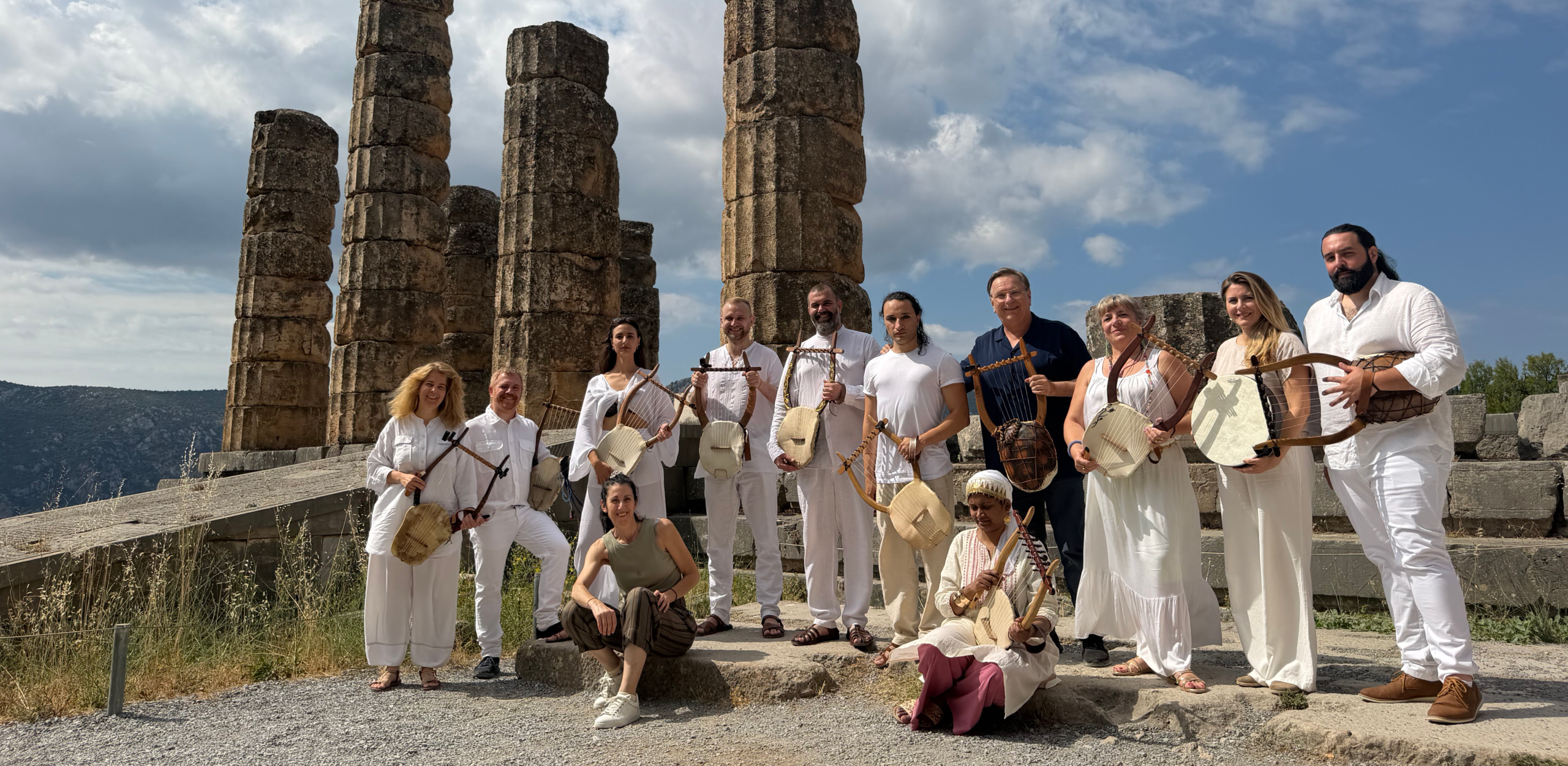
The Hymn to Bacchus at Delphi
Anecdote of the Month

Anecdote of the month by Nikos Xanthoulis
The great conductor Andreas Paridis had a habit of making a spectacular leap into the air at a particular moment in whatever opera he happened to be conducting, using the jump to emphasize the accent of the following measure.
During the dress rehearsal of Puccini’s La fanciulla del West, the leap was more impressive than ever. A few measures later, the principal horn player, who was seated in front of me, suddenly turned around and said:
“Tomorrow, I’m going to make sure he doesn’t jump.”
I was puzzled, but soon forgot all about it.
At the premiere, I saw Paridis preparing himself for the great leap when, at one particular entrance – at a moment when the audience would not be able to hear him – the principal horn suddenly called out:
“Hey!”
That was it. He never jumped.
Without missing a beat and while continuing to conduct, Paridis proceeded to shower our horn player with an extraordinary stream of curses.
Naturally, during the break, he threw his arms around him – and we all had a good laugh together.
The Third Cycle of “The Ancient Lyre in Education” Successfully Completed

We are delighted to announce the successful completion of the third cycle of the educational program “The Ancient Lyre in Education”, offered by the Center for Education and Lifelong Learning (KEDIVIM) of Democritus University of Thrace, marking the conclusion of yet another important journey of study, education, and experiential engagement with the ancient Greek lyre.
Participants had the opportunity to put what they had learned into practice, presenting the lyre and its repertoire in places of exceptional historical and symbolic significance.
“Lyric Eleni” in Maroneia
At ancient Maroneia, “Lyric Eleni” was presented in a musical and theatrical encounter between the ancient Greek lyre, the spoken word, and ancient drama. The performance marked one of the highlights of the program’s concluding activities, giving participants the opportunity to experience the lyre not merely as an object of study, but as a living instrument of artistic expression.

The Delphic Hymn at the Temple of Apollo
The journey continued to Delphi, a place inextricably associated with Apollo, music, and the lyre. There, within the archaeological site and before the Temple of Apollo, the Delphic Hymn was performed, creating a remarkable connection between this ancient musical monument, the instrument itself, and the place with which this music is historically associated.
This was one of the most symbolic experiences of the program: the ancient Greek lyre returned to one of the most significant places in Greece’s musical history, not as a museum artifact, but as living sound.

At the Museum of the Delphic Festivals – House of Angelos and Eva Sikelianos
The journey concluded with a concert at the Museum of the Delphic Festivals – House of Angelos and Eva Sikelianos, a place of particular significance in the modern history of efforts to reconnect contemporary Greek culture with its ancient heritage.
In the welcoming garden of the home of Angelos Sikelianos and Eva Palmer, who envisioned and brought to life the Delphic Festivals of 1927 and 1930, the presence of the ancient lyre acquired a special symbolic significance: a contemporary effort toward revival encountered a place that is itself a monument to an earlier, ambitious vision of transforming ancient Greek cultural heritage into a living creative force in the present.

The completion of the third cycle marks more than the conclusion of another educational program. It represents another step toward fostering a new generation of musicians who come to know the lyre through study, but above all through the living experience of making music.
From education to the stage, and from Maroneia to Delphi, the ancient lyre continues to return to places where sound, poetry, and history meet once again.
The Mixolydian Harmonia

Among the ancient Greek harmoniai, the Mixolydian occupies a distinctive place. Ancient authors associate it with passion, emotional intensity, and, above all, tragic expression. Pseudo-Plutarch describes it as patheticē—emotionally affecting or impassioned—and identifies it as particularly well suited to tragedy.
According to Aristoxenus, Sappho was the first to use the Mixolydian harmonia. From the Lesbian poetic tradition, it subsequently passed into the work of the Athenian tragedians, who combined it with the Dorian. This pairing was not accidental. The Dorian was regarded as noble, majestic, and courageous, whereas the Mixolydian expressed inner suffering, emotional intensity, and the heightened force of feeling. Tragedy, as an art form that brings together the heroic and the deeply human experience of passion and suffering, found in these two harmoniai an ideal musical foundation.

The same author preserves a second tradition. Music theorists attributed the invention of the Mixolydian not to Sappho, but to Pythocleides, one of the most important musical teachers of the 5th century BCE, also known to us through Plato. According to this tradition, the Athenian musician Lamprocles recognized that the diazeuxis—the disjunction within the system—lay in a different position from that assumed by earlier theorists, and consequently reformulated the structure of the harmonia. This evidence suggests that the Mixolydian was not merely a style or an ethos, but also an object of theoretical analysis and refinement.
Even its name raises intriguing questions. The prefix mixo- means “mixed,” although it is not clear exactly what is being mixed. One possible interpretation is that the harmonia was associated with Lydia and the musical culture of the opposite coast of Asia Minor, with which Lesbos maintained particularly close relations. The name may therefore reflect a musical synthesis or interaction between the Lesbian tradition of Sappho and Lydian musical elements. Although this hypothesis cannot be demonstrated conclusively, it is entirely compatible with the geographical and cultural realities of the north-eastern Aegean during the Archaic period.
Later theory classified the Mixolydian as the highest of the traditional harmoniai. The word “highest,” however, immediately raises a number of interpretative problems. It is not always clear whether ancient authors are referring to actual pitch height, to the position of the harmonia within a theoretical system, or to a broader aesthetic quality associated with its ethos.
If we consider this alongside Sappho’s performance practice, which involved the barbitos—an instrument with an unmistakably low register—rather than the lyre, another possibility emerges. One might suppose that Sappho’s use of the barbitos, and more generally its use among Lesbian poets, allowed high vocal lines to be supported by a low instrumental foundation. We should not forget that we are speaking, in Sappho’s case, of female voices. This interpretation, however, is rather restrictive, since the barbitos was used more generally by Lesbian poets. Likewise, references to a “high” range may simply reflect a composer’s choice to place the music in an upper register, perhaps as part of the ethos or character associated with the harmonia.

It is precisely this ethos that appears to have preserved the memory of the Mixolydian harmonia. For the ancient Greeks, the Mixolydian became the voice of emotion, lament, dramatic tension, and ultimately tragedy itself.
If we accept that Sappho’s original Mixolydian was indeed the harmonia later subjected to theoretical transformation by Pythocleides and Lamprocles, then the term “Mixolydian” may signify more than simply “mixed Lydian.” It may point from the outset to a borderland musical identity: a music born in the passage between Lesbos and Lydia, between the Greek and the Eastern worlds. This interpretation is not explicitly attested in the sources, but it corresponds strikingly with the geography, history, and cultural character of Sappho’s world.
Let us now attempt a more practical approach to the Mixolydian harmonia. I should repeat here that any discussion of the ethos of the ancient harmoniai inevitably reflects the perception of the modern ear. There is no way to prove that an equivalent listening experience existed in antiquity.
If we take the octave
B – C – D – E – F – G – A – B,
and assume that the lyre is tuned according to a natural A minor collection, we immediately notice that the fifth B-F is the only fifth that is not perfect, but diminished. The mournful quality of this interval—always depending, of course, on how the performer articulates it—is clearly recognizable in the blues scale of jazz.
If we take B as the tonal centre, my personal experience in setting the choral passages of tragedy to music suggests a distinctly interrogative character, almost like a musical question mark. Jazz musicians would identify this intervallic configuration with the Locrian mode. This comparison concerns only the arrangement of intervals; it should not be understood as an identification of the ancient ethos or function of the Mixolydian harmonia with the modern Locrian mode.
If, on the other hand, we regard E—the mese—as the tonal centre, we can readily perceive a correspondence with the Arabo-Persian Uşşak tradition. The medieval Phrygian mode likewise begins on E, although its character is, of course, different. Yet when we consider the Phrygian cadence of Western European harmony, the expressive character changes completely.
Personally, when I use this harmonia with E as its centre, I tend toward an ethos closer to the medieval tradition. The field, however, remains entirely open to different interpretations.
With E functioning as mese, the connection with the Dorian harmonia also becomes apparent, since the Dorian is contained within the octave E-E. It is worth recalling here that the mese—perhaps we might cautiously call it a tonal centre—of the Dorian is A.
The relationship B-E-A therefore creates a particularly fertile field for modulation among three harmoniai that may be perceived as closely related, if we borrow—only analogically—the modern European concept of proximity between related scales. In another sense, we might simply call them interconnected systems.
If you have not yet begun your journey with the lyre, we invite you to enroll in our free introductory course and become part of the growing International Lyre Society community.
The first step is open to all – the path continues as far as you wish to go.
Editorial Credits
Articles: Dr. Nikos Xanthoulis
Copy Editing:
Dr. Evangelia Kopsalidou
Paul Amiel Stewart (English Version)
Editorial Coordination & Visual Curation:
Ilias Zervas
Published by the International Lyre Society
ILS Newsletter – August 2026 | Issue 06
ILS Newsletter – Αύγουστος 2026 | Τεύχος 06
Ένα Σημαντικό Ορόσημο για την ILS Academy
Με ιδιαίτερη χαρά ανακοινώνουμε ότι τα εκπαιδευτικά προγράμματα της International Lyre Society Academy τελούν πλέον υπό την αιγίδα του Υπουργείου Πολιτισμού.
Η αναγνώριση αυτή αποτελεί ένα σημαντικό ορόσημο για την International Lyre Society και, ευρύτερα, για τη συνεχιζόμενη προσπάθεια αναβίωσης της αρχαίας ελληνικής επτάχορδης λύρας ως ενός ζωντανού οργάνου μουσικής δημιουργίας, εκπαίδευσης και πολιτιστικής έκφρασης.
Από την πρώτη στιγμή, η ILS Academy δημιουργήθηκε με έναν ξεκάθαρο στόχο: να προσφέρει μια οργανωμένη και προσιτή εκπαιδευτική διαδρομή σε όσους επιθυμούν να γνωρίσουν και να μελετήσουν την αρχαία ελληνική λύρα, συμβάλλοντας παράλληλα στη δημιουργία μιας νέας γενιάς λυριστών που θα μεταφέρει αυτή τη σπουδαία μουσική παράδοση στο μέλλον.
Τα εκπαιδευτικά προγράμματα της Ακαδημίας συνδυάζουν την ιστορική και μουσικολογική έρευνα με τη σύγχρονη διδασκαλία και εκτελεστική πρακτική, εισάγοντας τους μαθητές όχι μόνο στην τεχνική του οργάνου, αλλά και στη μουσική σκέψη, το ρεπερτόριο και τον ευρύτερο πολιτιστικό κόσμο που το περιβάλλει.
Η αιγίδα του Υπουργείου Πολιτισμού αποτελεί μια σημαντική αναγνώριση αυτής της εκπαιδευτικής και πολιτιστικής αποστολής. Για την International Lyre Society αποτελεί ταυτόχρονα μια ισχυρή ενθάρρυνση να συνεχίσουμε την ανάπτυξη της Ακαδημίας, να διευρύνουμε διεθνώς την πρόσβαση στην εκπαίδευση της λύρας και να δημιουργούμε γέφυρες ανάμεσα στην έρευνα, την εκτέλεση, την οργανοποιία και την εκπαίδευση.
Πάνω απ’ όλα, όμως, αυτό το ορόσημο ανήκει στη διαρκώς αναπτυσσόμενη κοινότητα που έχει δημιουργηθεί γύρω από τη λύρα: στους μαθητές, τους διδάσκοντες, τους ερευνητές, τους μουσικούς, τους συνεργάτες, τους οργανοποιούς και τους φίλους μας, που μοιράζονται μαζί μας την πεποίθηση ότι αυτό το ξεχωριστό όργανο δεν πρέπει να αποτελεί απλώς ένα αντικείμενο του παρελθόντος, αλλά μια ζωντανή μουσική φωνή του παρόντος.
Είμαστε βαθιά ευγνώμονες για αυτή την αναγνώριση και ακόμη πιο ενθουσιασμένοι για όσα ακολουθούν.
Η λύρα έχει ένα σπουδαίο παρελθόν. Μαζί, της δίνουμε μέλλον.
Ο Ύμνος στον Βάκχο στους Δελφούς
Ανέκδοτο του Μήνα
Ανέκδοτο του μήνα από τον Νίκο Ξανθούλη
Ο μεγάλος μαέστρος Ανδρέας Παρίδης είχε τη συνήθεια σε κάποιο συγκεκριμένο σημείο της εκάστοτε όπερας να πηδάει εντυπωσιακά στον αέρα, τονίζοντας το accent του επόμενου μέτρου.
Στη Γενική πρόβα της Fanciulla del West του Puccini ο πήδος ήταν ακόμα πιο εντυπωσιακός. Ξαφνικά μετά από λίγα μέτρα ο πρώτος κορνίστας που καθόταν μπροστά μου γυρνάει και μου λέει:
“Αύριο θα τον κάνω να μην πηδήξει”.
Απόρησα μεν το ξέχασα σε λίγο δε.
Στην πρεμιέρα τον βλέπω να προετοιμάζεται για το μεγάλο πήδημα όταν ο 1ο κορνίστας του φωνάζει σε μια συγκεκριμένη αττάκα που δεν θα ακουγόταν στο κοινό:
“Εεεπ!”
Αυτό ήταν! Δεν πήδηξε.
Συνεχίζοντας να διευθύνει παρακάτω στόλισε με απίθανες βρισιές τον κορνίστα μας.
Φυσικά στο διάλειμμα τον πήρε αγκαλιά και γελάσαμε όλοι μαζί.
Ολοκληρώθηκε με Επιτυχία ο 3ος Κύκλος του Προγράμματος «Η Αρχαία Λύρα στην Εκπαίδευση»

Με ιδιαίτερη χαρά ολοκληρώθηκε ο 3ος κύκλος του επιμορφωτικού προγράμματος «Η Αρχαία Λύρα στην Εκπαίδευση» του ΚΕ.ΔΙ.ΒΙ.Μ. του Δημοκριτείου Πανεπιστημίου Θράκης, κλείνοντας ακόμη έναν σημαντικό κύκλο μελέτης, εκπαίδευσης και βιωματικής προσέγγισης της αρχαίας ελληνικής λύρας.
Οι συμμετέχοντες είχαν την ευκαιρία να μεταφέρουν στην πράξη όσα διδάχθηκαν, παρουσιάζοντας τη λύρα και το ρεπερτόριό της σε χώρους με ιδιαίτερη ιστορική και συμβολική σημασία.
Η «Λυρική Ελένη» στη Μαρώνεια
Στην αρχαία Μαρώνεια παρουσιάστηκε η «Λυρική Ελένη», σε μια μουσική και σκηνική συνάντηση της αρχαίας ελληνικής λύρας με τον λόγο και το αρχαίο δράμα. Η παρουσίαση αποτέλεσε έναν από τους σημαντικότερους σταθμούς της ολοκλήρωσης του προγράμματος, δίνοντας στους συμμετέχοντες τη δυνατότητα να βιώσουν τη λύρα όχι απλώς ως αντικείμενο μελέτης, αλλά ως ζωντανό όργανο καλλιτεχνικής έκφρασης.
Ο Δελφικός Ύμνος στον Ναό του Απόλλωνα
Το ταξίδι συνεχίστηκε στους Δελφούς, σε έναν τόπο άρρηκτα συνδεδεμένο με τον Απόλλωνα, τη μουσική και τη λύρα. Εκεί, στον αρχαιολογικό χώρο και μπροστά στον Ναό του Απόλλωνα, παρουσιάστηκε ο Δελφικός Ύμνος, δημιουργώντας μια ξεχωριστή σύνδεση ανάμεσα στο αρχαίο μουσικό μνημείο, το ίδιο το όργανο και τον χώρο με τον οποίο η μουσική αυτή συνδέεται ιστορικά.
Η στιγμή αυτή αποτέλεσε μία από τις πλέον συμβολικές εμπειρίες του προγράμματος: η αρχαία ελληνική λύρα επέστρεψε σε έναν από τους σημαντικότερους τόπους της μουσικής ιστορίας της Ελλάδας, όχι ως μουσειακό έκθεμα, αλλά ως ζωντανός ήχος.
Στο Μουσείο Δελφικών Εορτών – Οικία Άγγελου και Εύας Σικελιανού
Η διαδρομή ολοκληρώθηκε με συναυλία στο Μουσείο Δελφικών Εορτών – Οικία Άγγελου και Εύας Σικελιανού, έναν χώρο με ξεχωριστή θέση στη νεότερη ιστορία της προσπάθειας επανασύνδεσης του σύγχρονου ελληνικού πολιτισμού με την αρχαία του κληρονομιά.
Μέσα στην οικία του Άγγελου Σικελιανού και της Εύας Πάλμερ, των ανθρώπων που οραματίστηκαν και πραγματοποίησαν τις Δελφικές Εορτές του 1927 και του 1930, η παρουσία της αρχαίας λύρας απέκτησε έναν ιδιαίτερο συμβολισμό: μια σύγχρονη προσπάθεια αναβίωσης συνάντησε έναν χώρο που αποτελεί ο ίδιος μνημείο μιας προηγούμενης μεγάλης προσπάθειας να καταστεί η αρχαία ελληνική πολιτιστική κληρονομιά ζωντανή δημιουργική δύναμη του παρόντος.
Η ολοκλήρωση του τρίτου κύκλου δεν σηματοδοτεί απλώς το τέλος ακόμη ενός εκπαιδευτικού προγράμματος. Αποτελεί ένα ακόμη βήμα στη δημιουργία μιας νέας γενιάς μουσικών που γνωρίζουν τη λύρα μέσα από τη μελέτη, αλλά κυρίως μέσα από την ίδια τη μουσική πράξη.
Από την εκπαίδευση στη σκηνή και από τη Μαρώνεια στους Δελφούς, η αρχαία λύρα συνεχίζει να επιστρέφει στους χώρους όπου ο ήχος, ο λόγος και η ιστορία συναντιούνται ξανά.
Η Μιξολύδια αρμονία

Ανάμεσα στις αρχαίες ελληνικές αρμονίες, η Μιξολύδια κατέχει μια ιδιαίτερη θέση. Οι αρχαίοι συγγραφείς τη συνδέουν με το πάθος, τη συγκίνηση και κυρίως με τον τραγικό λόγο. Ο ψευδο-Πλούταρχος τη χαρακτηρίζει «παθητική» και σημειώνει ότι είναι η πλέον κατάλληλη για την τραγωδία.
Σύμφωνα με τον Αριστόξενο, πρώτη χρησιμοποίησε τη Μιξολύδια η Σαπφώ. Από τη λεσβιακή ποιητική παράδοση η αρμονία αυτή πέρασε στους τραγικούς ποιητές της Αθήνας, οι οποίοι τη συνδύασαν με τη Δώρια. Η σύνθεση αυτή δεν ήταν τυχαία. Η Δώρια θεωρούνταν αρμονία ευγενής, μεγαλοπρεπής και ανδρεία, ενώ η Μιξολύδια εξέφραζε τον ψυχικό πόνο, τη συγκίνηση και την ένταση του συναισθήματος. Η τραγωδία, ως τέχνη που συνδυάζει το ηρωικό με το ανθρώπινο πάθος, βρήκε σε αυτές τις δύο αρμονίες το ιδανικό μουσικό της υπόβαθρο.
Ο ίδιος συγγραφέας διασώζει και μια δεύτερη παράδοση. Οι θεωρητικοί της μουσικής απέδιδαν την επινόηση της Μιξολυδίας όχι στη Σαπφώ αλλά στον Πυθοκλείδη, έναν από τους σημαντικότερους μουσικούς δασκάλους του 5ου αιώνα π.Χ., γνωστό και από τον Πλάτωνα. Κατά την ίδια παράδοση, ο Αθηναίος μουσικός Λαμπροκλής αντιλήφθηκε ότι η διάζευξη του συστήματος βρισκόταν σε διαφορετική θέση από εκείνη που πίστευαν οι προγενέστεροι και αναδιαμόρφωσε τη δομή της αρμονίας. Η πληροφορία αυτή δείχνει ότι η Μιξολύδια δεν ήταν απλώς ένα ύφος ή ένα ήθος αλλά και αντικείμενο θεωρητικής επεξεργασίας.
Ακόμη και η ονομασία της προκαλεί ενδιαφέρον. Το πρώτο συνθετικό «μιξο-» σημαίνει «αναμεμειγμένη», χωρίς όμως να είναι σαφές τι ακριβώς αναμειγνύεται. Μια πιθανή ερμηνεία είναι ότι η αρμονία συνδέθηκε με τη Λυδία και τον μουσικό πολιτισμό της απέναντι μικρασιατικής ακτής, με την οποία η Λέσβος διατηρούσε στενότατες σχέσεις. Δεν αποκλείεται λοιπόν η ονομασία να αντανακλά μια μουσική σύνθεση ή αλληλεπίδραση ανάμεσα στη λεσβιακή παράδοση της Σαπφώς και σε λυδικά μουσικά στοιχεία. Αν και η υπόθεση αυτή δεν μπορεί να αποδειχθεί οριστικά, ταιριάζει με τη γεωγραφική και πολιτισμική πραγματικότητα του βορειοανατολικού Αιγαίου κατά τους αρχαϊκούς χρόνους.
Η μεταγενέστερη θεωρία κατέταξε τη Μιξολύδια ως την υψηλότερη από τις παραδοσιακές αρμονίες. Η λέξη «υψηλότερη βέβαια, βάζει διάφορα προβλήματα. Ο χαρακτηρισμός “υψηλοτέρα” δημιουργεί ωστόσο ερμηνευτικά προβλήματα. Δεν είναι πάντοτε σαφές αν οι αρχαίοι αναφέρονται σε πραγματικό τονικό ύψος, στη θέση της αρμονίας μέσα στο θεωρητικό σύστημα ή σε ένα γενικότερο αισθητικό χαρακτηριστικό που συνδεόταν με το ήθος της.
Αν το συνδυάσουμε με τη σαπφική πρακτική που περιλαμβάνει βάρβιτο (ένα ολοφάνερα μπάσο όργανο) αντί για λύρα. Θα μπορούσε μάλιστα να υποτεθεί ότι η χρήση της βαρβίτου από τη Σαπφώ και γενικότερα από τους Λέσβιους ποιητές επέτρεπε την υποστήριξη υψηλών φωνητικών γραμμών πάνω σε χαμηλό οργανικό υπόβαθρο. Μην ξεχνάμε ότι μιλάμε για γυναικείες φωνές. Αυτή η σκέψη είναι όμως, αρκετά περιοριστική γιατί γενικά οι Λέσβιοι ποιητές χρησιμοποιούσαν βάρβιτο. Η αναφορά επίσης στην υψηλή έκταση μπορεί κάλλιστα να αναφέρεται στην επιλογή του συνθέτη να παίζεται στην υψηλή περιοχή που περιλαμβάνεται και στο ήθος (χαρακτήρα) της αρμονίας.
Γι αυτό το ήθος φαίνεται να διατηρείται η μνήμη της συγκεκριμένης αρμονίας. Για τους αρχαίους Έλληνες η Μιξολύδια ήταν η φωνή της συγκίνησης, του θρήνου, της δραματικής έντασης και τελικά της ίδιας της τραγωδίας.
Αν δεχτούμε ότι η αρχική σαπφική Μιξολύδια ήταν πράγματι η αρμονία που αργότερα μετασχηματίστηκε θεωρητικά από τον Πυθοκλείδη και τον Λαμπροκλή, τότε το όνομα «Μιξολύδια» ίσως δεν σημαίνει απλώς «μικτή Λυδία», αλλά υποδηλώνει ήδη από την αρχή μια μεθοριακή μουσική ταυτότητα: μια μουσική που γεννήθηκε στο πέρασμα ανάμεσα στη Λέσβο και τη Λυδία, ανάμεσα στον ελληνικό και τον ανατολικό κόσμο. Αυτή η ερμηνεία δεν μαρτυρείται ρητά στις πηγές, αλλά συμφωνεί εντυπωσιακά με τη γεωγραφία, την ιστορία και τον χαρακτήρα της Σαπφούς.
Ας προσπαθήσουμε τώρα να περάσουμε σε μια πιο πρακτική προσέγγιση της μιξολύδιας αρμονίας. Θα επαναλάβω εδώ ότι η πρόσληψη του ήθους των αρμονιών αφορά το σύγχρονο αυτί και δεν υπάρχει κανένας τρόπος να αποδειχθεί ή να υποστηριχθεί κάτι αντίστοιχο για την αρχαιότητα.
Με δεδομένη την οκτάβα σι-ντο-ρε-μι-φα-σολ-λα-σι παρατηρούμε ότι αν έχουμε χορδίσει την λύρα σε μια φυσική λα ελάσσονα το διάστημα της 5ης σι-φα είναι το μόνο που δεν είναι καθαρή 5η αλλά ελαττωμένη. Το θρηνητικό ύφος του διαστήματος αυτού (ανάλογα και με τον τρόπο που το παίζει ο ερμηνευτής πάντα) είναι ξεκάθαρο στη μπλού κλίμακα της τζαζ. Αν υποθέσουμε ότι παίρνουμε ως τονική το σι η προσωπική μου εμπειρία στις μελοποιήσεις των χορικών της τραγωδίας δίνει τον χαρακτήρα ενός ερωτηματικού. Οι τζαζίστες ονομάζουν αυτή την αρμονία (τρόπο ή mode) Λόκριο. Η ταύτιση αυτή αφορά αποκλειστικά τη διαστηματική διάταξη και όχι το αρχαίο ήθος ή τη λειτουργία της αρμονίας.
Αν θεωρήσουμε ως τονική το μι (μέση) τότε κάλλιστα μπορούμε να βρούμε την αντιστοιχία στο αραβοπερσικό ουσάκ. Ο φρύγιος μεσαιωνικός τρόπος είναι επίσης από μι. Το ύφος βέβαια είναι διαφορετικό. Αν όμως, δούμε τη φρύγια πτώση της δυτικοευρωπαϊκής αρμονίας αλλάζει εντελώς ο χαρακτήρας. Προσωπικά χρησιμοποιώ την αρμονία από μι σε ένα ήθος πιο κοντινό στην μεσαιωνική παράδοση αλλά το πεδίο είναι σαφώς απολύτως ελεύθερο για διάφορες ερμηνείες. Με το μι ως μέση φαίνεται και η σύνδεση με τη δώρια αρμονία η οποία περιλαμβάνεται στην οκτάβα μι-μι. Εδώ θυμίζω ότι η μέση (τονική ίσως;) της δώριας είναι το λα. Η σχέση σι-μι-λα κάνει ευπρόσδεκτες μετατροπίες σε τρεις αρμονίες που εμφανίζονται ως κοντινές (με την αντίληψη της εγγύτητας των σχετικών κλιμάκων της ευρωπαϊκής αρμονίας – αλλιώς σχετικές).
Αν δεν έχετε ακόμη ξεκινήσει το ταξίδι σας με τη λύρα, σας προσκαλούμε να εγγραφείτε στο δωρεάν εισαγωγικό μας μάθημα και να γίνετε μέρος της διαρκώς αναπτυσσόμενης κοινότητας της International Lyre Society.
Το πρώτο βήμα είναι ανοιχτό σε όλους – η πορεία συνεχίζεται όσο μακριά επιθυμείτε να φτάσετε.
Συντακτική Ταυτότητα
Άρθρα: Δρ. Νίκος Ξανθούλης
Επιμέλεια Κειμένων:
Δρ. Ευαγγελία Κοψαλίδου
Paul Amiel Stewart (Αγγλική έκδοση)
Συντονισμός Έκδοσης & Οπτική Επιμέλεια:
Ηλίας Ζέρβας
Έκδοση: International Lyre Society